

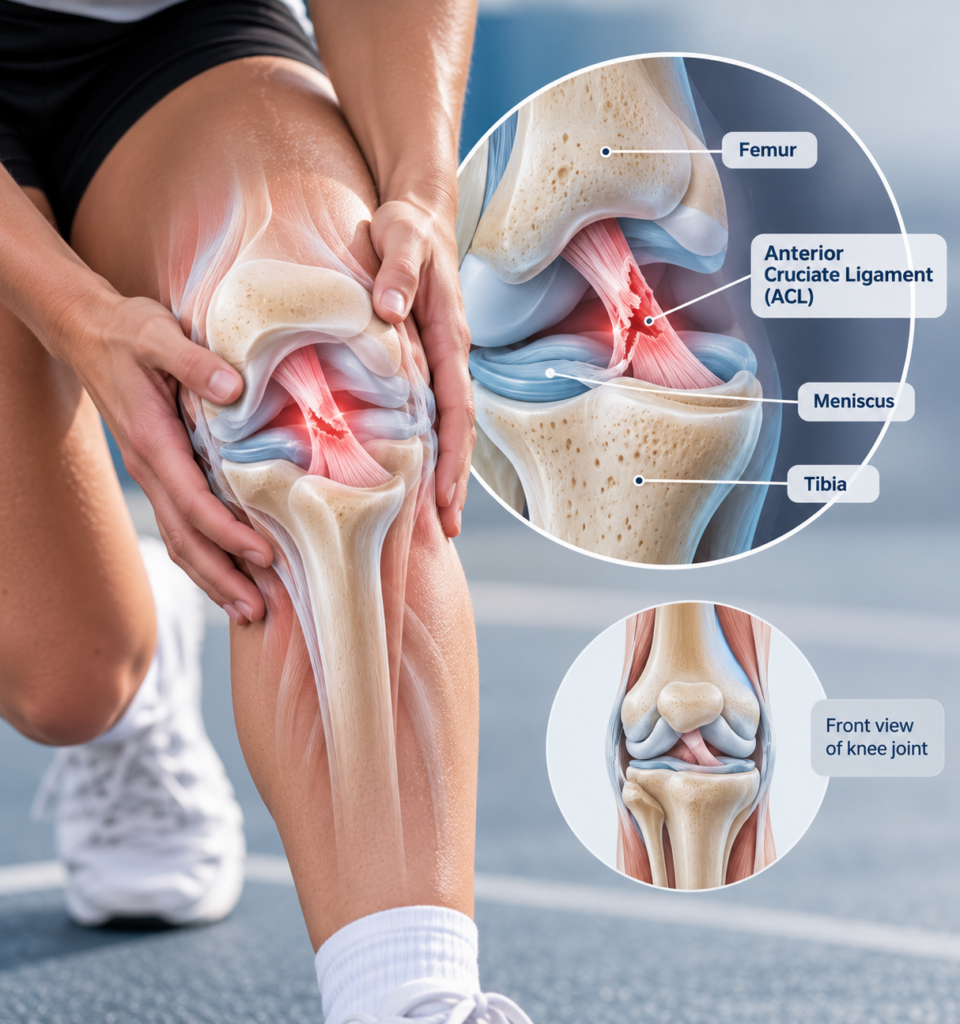
Sustaining an Anterior Cruciate Ligament (ACL) tear can feel like a sudden pause on your active life. Whether you are an athlete eager to get back to pivoting sports or simply aiming to return to pain-free daily activities, understanding what happens to your knee—and specifically to your graft—is essential for a safe, successful recovery.
ACL reconstruction is not merely a mechanical dynamic fix where a tendon graft is installed and immediately ready to go. It is a biological process. The graft undergoes a structural transformation called ligamentization, during which imported tissue adapts, revascularizes, and gradually transforms to mimic a native ACL.
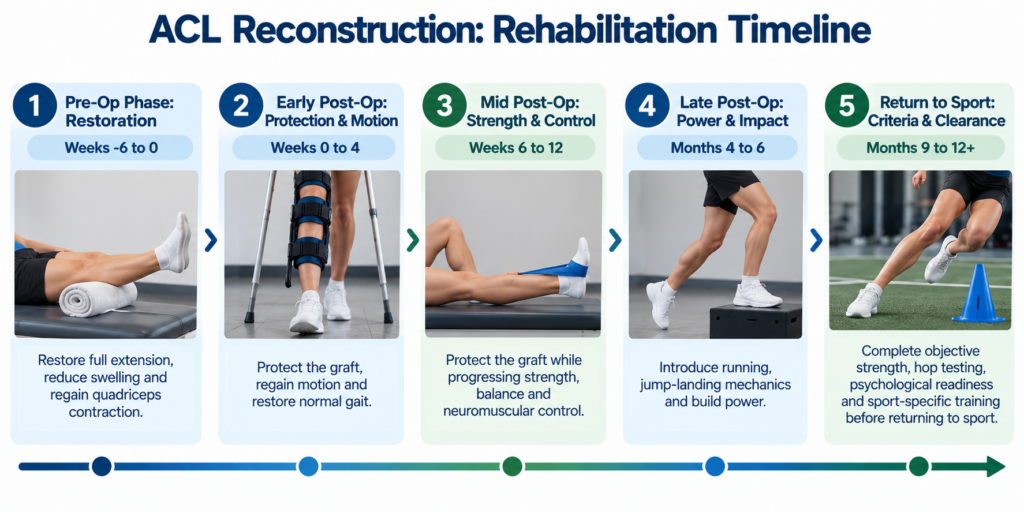
Phase 1: Pre-Habilitation (“Pre-Hab”) — Building the Foundation
Timeline: Injury to Surgery (Typically 3 to 8+ weeks)
Rushing into surgery on a swollen, stiff knee with poor quadriceps firing is one of the strongest predictors of prolonged post-operative deficits. Pre-hab focuses on optimizing the knee joint environment before surgery.
- Primary Objectives:
- Eliminate effusion (joint swelling) and restore normal temperature.
- Achieve full knee extension symmetry ($0^\circ$) and full passive flexion.
- Re-establish quadriceps motor control (e.g., resolving arthrogenic muscle inhibition).
- Normalize walking gait mechanics without a limp.
Clinical Insight: Patients who achieve full range of motion and at least 80% strength symmetry relative to the uninjured side prior to surgery consistently demonstrate significantly better outcomes at 1 and 2 years post-op.
The Biological Timeline: Graft Ligamentization
Once surgical reconstruction takes place—whether using a bone-patellar tendon-bone (BPTB), hamstring, or quadriceps tendon autograft—the graft goes through three primary biological stages:
1. Early Necrosis & Healing Phase (Weeks 0–4 Post-Op)
- Biological State: The transplanted tendon tissue loses its original blood supply, resulting in central cellular necrosis. The graft acts primarily as a mechanical structural scaffold held in place by fixation devices (screws, buttons).
- Clinical Focus: Protecting the graft while regaining full active/passive extension, minimizing swelling, and maintaining patellar mobility.
2. Proliferation & Revascularization Phase (Weeks 6–12 Post-Op)
- Biological State: This is the graft’s weakest point. Synovial tissue covers the graft, and new blood vessels begin to invade from the periphery (revascularization). Collagen structural organization weakens as old fibers break down before new collagen aligns.
- Clinical Focus: Avoid open-kinetic-chain quadriceps strain near extension ($0^\circ – 30^\circ$) under high loads. Rehabilitation focuses on closed-kinetic-chain exercises (squats, leg press) and neuromuscular re-education.
3. Remodeling & Maturation Phase (Months 3 to 12–24 Post-Op)
- Biological State: Cellular density decreases and collagen fibrils realign along lines of mechanical stress, gradually taking on the histological appearance of a native ACL ligament.
- Clinical Focus: Progressive overload, high-velocity deceleration, plyometrics, multi-planar agility, and sport-specific biomechanics.
Why “Time-Based” Rehabilitation Is Outdated
Clearing an athlete based solely on the calendar (e.g., “6 months post-op”) carries a significantly higher risk of secondary ACL rupture. Modern physiotherapy relies on criterion-based progression.
| Phase Progression | Objective Clearance Benchmark |
| Running Readiness | Limb Symmetry Index (LSI) $>80\%$ on Quad strength; single-leg squat stability; zero effusion. |
| Plyometrics & Agility | Controlled single-leg landing biomechanics without dynamic knee valgus. |
| Full Return to Sport | $>90\%$ LSI on Isokinetic Quad/Hamstring strength; $>90\%$ LSI on hop tests; ACL-RSI score $>75\%$. |
Achieving these milestones safely requires balancing mechanical loading with biological healing—a process best guided by structured, evidence-based physiotherapy.
Key References
- Failla, M. J., et al. (2016). Does Extended Preoperative Rehabilitation Improve Outcomes 2 Years After ACL Reconstruction? The American Journal of Sports Medicine, 44(10), 2608–2614.
- Claes, S., et al. (2011). Ligamentization of ACL grafts in human subjects: a systematic review. Archives of Orthopaedic and Trauma Surgery, 131(11), 1575–1582.
- Grindem, H., et al. (2016). Simple decision rules reduce reinjury risk after anterior cruciate ligament reconstruction: the Delaware-Oslo ACL cohort study. British Journal of Sports Medicine, 50(13), 804–808.
- van Melick, N., et al. (2016). Evidence-based clinical practice update: practice guidelines for anterior cruciate ligament rehabilitation based on a systematic review. British Journal of Sports Medicine, 50(24), 1506–1515.