An anterior shoulder dislocation is more than a brief moment of joint disruption—it is a structural event that compromises both passive stabilizers and neural feedback loops. Once the humeral head translates off the glenoid rim, the labrum, glenohumeral ligaments, and anterior capsule undergo significant mechanical stress or tearing (such as a Bankart lesion).
When passive restraint is compromised, the burden of joint congruency shifts squarely onto the dynamic stabilizers: the rotator cuff, the long head of the biceps, and the scapulothoracic musculature.
Without targeted rehabilitation designed to restore active concavity compression and neuromuscular timing, the shoulder remains vulnerable to recurrent micro-instability and apprehension.
The Biomechanics of Dynamic Stability: Concavity Compression
The glenohumeral joint is inherently unstable, often compared to a golf ball sitting on a tee. Passive structures provide end-range restraint, but active stability throughout functional movement relies on concavity compression.
When the rotator cuff musculature contracts synchronously, it pulls the humeral head directly into the center of the glenoid fossa. This force vector increases the resistance against shear forces trying to displace the bone anteriorly.
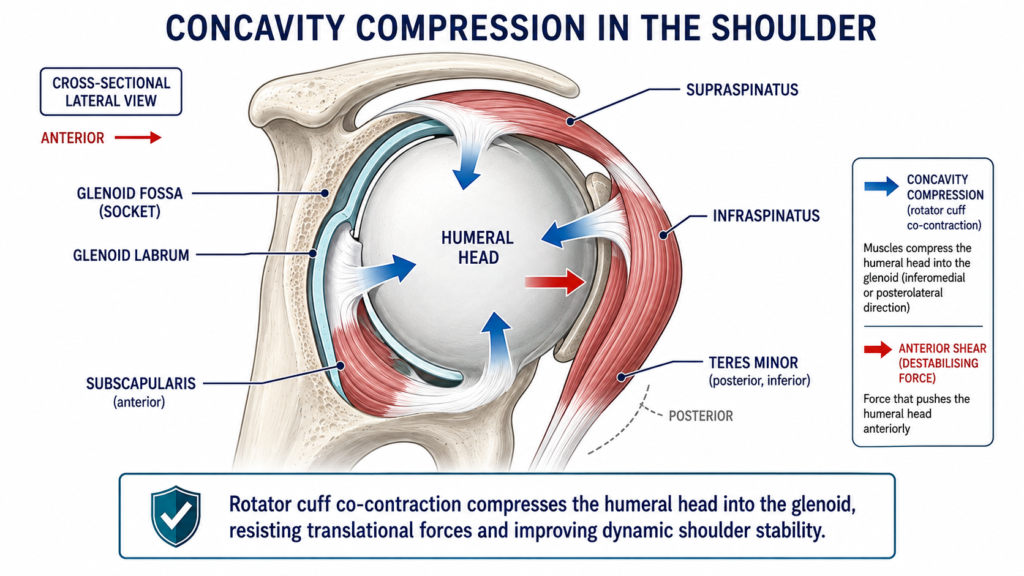
- Loss of Rotator Cuff Co-Contraction: Inhibitory feedback limits the subscapularis, infraspinatus, and teres minor from firing synchronously.
- Impaired Proprioception: Mechanoreceptors within the capsule and labrum are damaged, delaying the body’s protective reflex contraction during high-speed or end-range movements.
- Scapular Dyskinesis: Loss of periscapular control (particularly key serratus anterior and lower trapezius firing) tilts or protracts the glenoid, making anterior translation far easier for the humeral head.
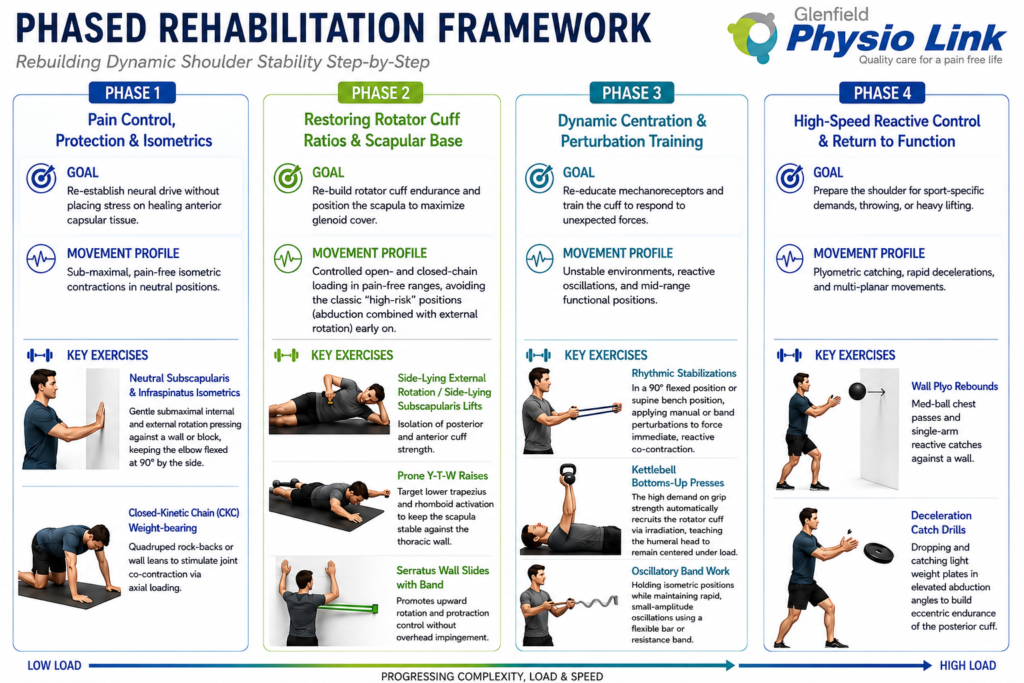
Phased Rehabilitation Framework
Rebuilding dynamic control requires progressing systematically from low-load neuromuscular recruitment to reactive, high-speed neuromuscular control.
Clinical Takeaway
Rehabilitation following an anterior dislocation cannot rely solely on basic elastic band rotations. To prevent recurrent instability, the rehabilitation program must intentionally restore proprioceptive reaction time, scapular posture, and dynamic concavity compression. By systematically progressing from static isometric co-contractions to unstable, reactive perturbations, patients can rebuild a robust dynamic wall that protects the joint long after passive structures have been compromised.
References
- Jaggi, A., & Lambert, S. (2010). Rehabilitation for shoulder instability. British Journal of Sports Medicine, 44(5), 333-340.
- Lippitt, S. B., & Matsen, F. A. (1993). Mechanisms of glenohumeral joint stability. Clinical Orthopaedics and Related Research, (291), 20-28.
- Olds, M., Ellis, R., Donaldson, K., & Parmar, P. (2015). Risk factors which predispose first-time traumatic anterior shoulder dislocations to recurrent instability in adults: a systematic review and meta-analysis. British Journal of Sports Medicine, 49(14), 913-922.
- Moroder, P., Danzinger, V., Maziak, N., et al. (2020). Characteristics of dynamic stabilization in anterior shoulder instability. Journal of Shoulder and Elbow Surgery, 29(4), 780-787.
- Eschler, A., et al. (2022). Neuromuscular control and proprioceptive deficits in non-operative management of shoulder instability: A systematic review. Archives of Orthopaedic and Trauma Surgery, 142(8), 1845-1856.