

An adductor strain—commonly referred to as a groin pull—is one of the most frustrating injuries in field sports. In football and rugby, where high-speed cutting, sudden deceleration, and maximal kicking are non-negotiable, the adductor longus muscle takes on immense mechanical stress. Returning to play without targeted eccentric and dynamic rehabilitation leaves athletes with up to a 20% reinjury rate.
Why Change of Direction Breeds Groin Strains
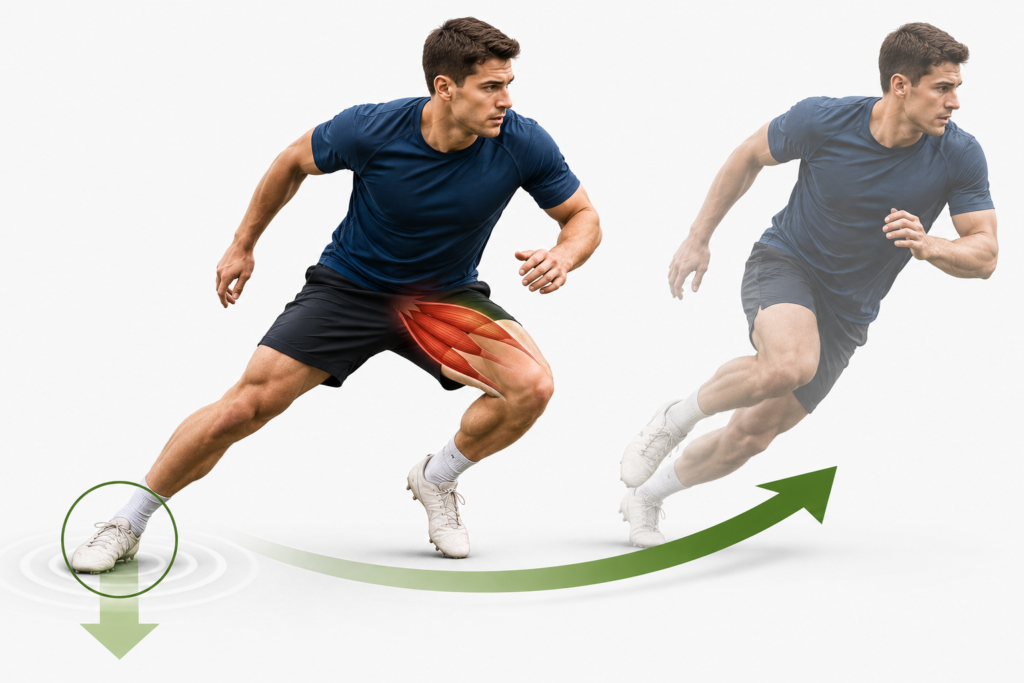
During a side-step cut, your outside leg plants to absorb force while the lead leg drives you sideways. The adductors must contract eccentrically (lengthening under tension) to stabilize the pelvis while simultaneously managing ground reaction forces up to 4–6 times body weight.
When adductor strength fails to keep pace with abductor (gluteus medius) force, or when muscle tender-points lack dynamic capacity, the tissue gives out.
Phased Rehabilitation Framework
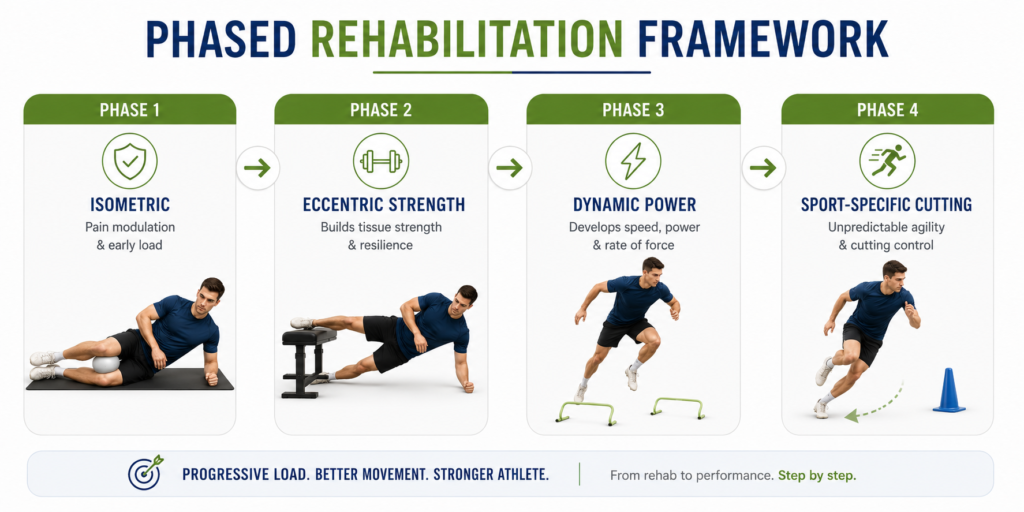
To transition from acute repair to match-ready agility, rehabilitation must progress systematically from isolated strength to dynamic high-speed velocity.
| Phase | Core Focus | Key Objective | Sample Exercise |
| Phase 1: Isometric | Pain modulation & early load | Maintain muscle activation without tissue shear | Submaximal isometric ball squeezes (0°, 45°, 90° hip flexion) |
| Phase 2: Eccentric Load | Architectural rebuilding | Increase fascicle length & heavy strength | Copenhagen Adduction (Level 1–3 variations) |
| Phase 3: Dynamic Power | Stretch-Shortening Cycle (SSC) | Rate of force development (RFD) in lateral planes | Lateral bounds, resisted side-shuffles, lateral plyometrics |
| Phase 4: Sport-Specific COD | Unpredictable agility | Deceleration control & reactive cutting | Reactive whistle-cuts, curved sprinting, tackle drills |
The Cornerstone Movement: The Copenhagen Adduction
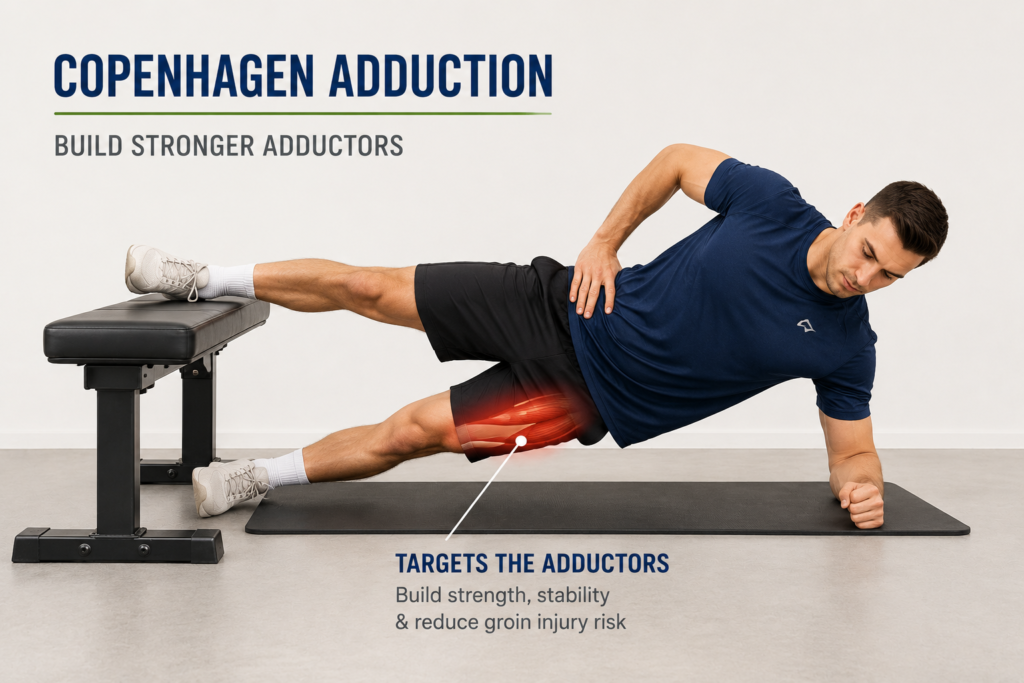
Research highlights the Copenhagen Adductor exercise as the gold standard for both rehabilitation and injury prevention. A study published in the British Journal of Sports Medicine demonstrated that incorporating Copenhagen exercises into training reduced groin injury risk in football players by 41%.
Protocol:
- Frequency: 2–3 times per week during strength phases; 1–2 times weekly for maintenance.
- Execution: Perform slow 3-second eccentric drops, holding the top plank position for 1 second.
Key Criteria Before Returning to Match Play
Before stepping back onto the pitch for full-contact rugby or competitive football, complete the following checklist:
- Symmetrical Isometric Strength: Adductor-to-Abductor strength ratio of at least 80–90% measured via hand-held dynamometry.
- Pain-Free Palpation & Stretch: Zero tenderness at the adductor longus insertion point on the pubic bone.
- High-Speed Cutting Test: Ability to perform a 90° cutting drill at 100% velocity without hesitation or compensatory mechanics.
References
- Haroy, J., Clarsen, B., Wiger, E. G., et al. (2019). The Copenhagen Adduction Exercise Reduces Groin Problems in Male Football Players: A Cluster-Randomized Controlled Trial. British Journal of Sports Medicine, 53(3), 150-157.
- Serner, A., van Eijck, C. H., Beumer, B. R., et al. (2015). Clinical Examination of Acute Groin Injuries in Athletes and Development of a Standardized Protocol. American Journal of Sports Medicine, 43(8), 1857-1864.
- Thorborg, K., Branci, S., Nielsen, M. P., et al. (2014). Eccentric Strength Training Reduces Groin Injury Incidence in Male Soccer Players. Scandinavian Journal of Medicine & Science in Sports, 24(4), 578-589.