

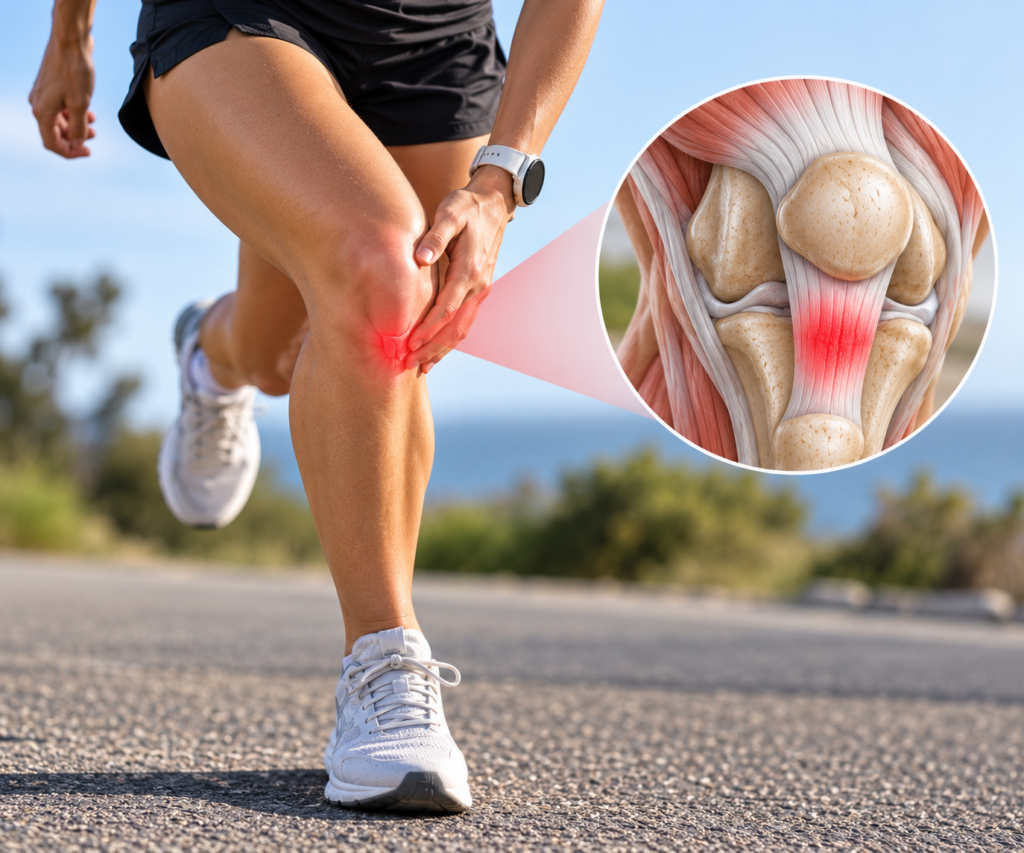
If you participate in sports involving jumping, heavy decelerations, or quick change-of-direction movements—such as basketball, volleyball, CrossFit, or track and field—you may be familiar with a persistent, anterior knee pain located just below the kneecap.
Often referred to as Jumper’s Knee, Patellar Tendinopathy is a common overuse injury that causes localized discomfort, stiffness, and reduced performance. Understanding why high-impact landing irritates the tendon—and how simple isometric exercises offer rapid relief—is key to managing this condition effectively.
Why High-Impact Landing Irritates the Patellar Tendon
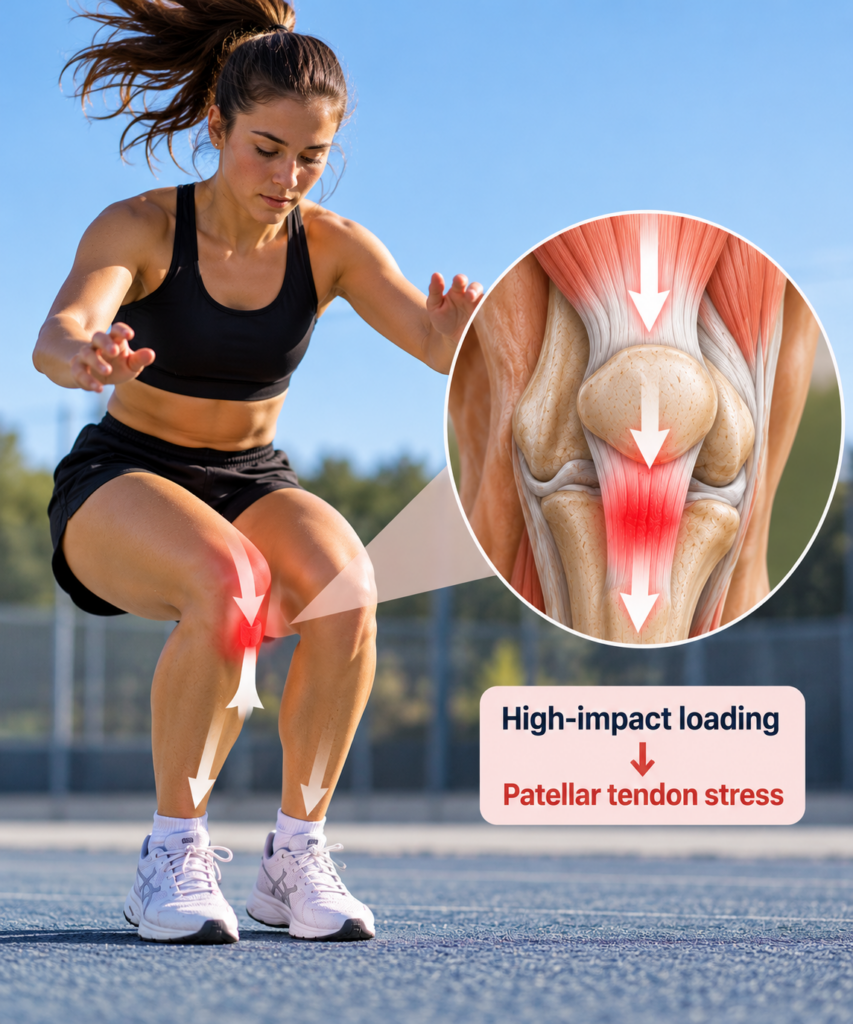
To understand why landing irritates the patellar tendon, it helps to examine its biomechanical function.
1. The Tendon as a Mechanical Spring
The patellar tendon acts as a high-capacity spring connecting the quadriceps muscles to the shinbone (tibia). During plyometric activities, the tendon undergoes rapid cycles of storage and release of mechanical energy:
- Energy Storage (Eccentric Loading): As you land from a jump, your quadriceps lengthen under tension to decelerate your body weight. The patellar tendon stretches rapidly to absorb kinetic energy.
- Energy Release (Concentric Loading): During propulsion or jumping off the ground, the tendon contracts rapidly to release that stored energy.
2. High Strain Rates and Cumulative Overload
High-impact landings subject the tendon to peak tensile loads equal to 6 to 8 times your body weight. When the rate or volume of this high-impact loading exceeds the tendon’s load-bearing capacity, micro-structural stress accumulates.
Unlike muscles, which have rich vascularization and adapt quickly to stress, tendons have lower metabolic activity and require more time to adapt and repair. Repeated high-impact landing without adequate recovery leads to:
- Disorganization of Collagen Matrices: Parallel collagen fibers become disrupted.
- Increased Ground Substance and Cell Proliferation: The body attempts rapid repair, causing localized swelling and thickened tendon structure.
- Neurovascular Ingrowth: Small new blood vessels and sensitive nerve endings grow into the tendon tissue, triggering localized tendon pain (tendinopathy).
How Isometric Holds Offer Relief and Immediate Pain Inhibition
Historically, rest or ice was recommended for tendon pain. However, modern tendon research demonstrates that targeted mechanical load is necessary to drive tendon adaptation and relieve pain.
Isometric exercises—muscle contractions where the muscle length and joint angle remain static—serve as a powerful tool in early-phase rehab.
1. Neurological Pain Inhibition
Research led by Dr. Ebonie Rio and colleagues (2015) revealed that heavy isometric holds trigger an immediate cortical inhibition effect.
High-load isometric contractions reduce cortical inhibition in the motor cortex, reducing motor neuron excitability and blunting local pain signaling. A single session of heavy isometric holds can reduce patellar tendon pain for several hours, providing an immediate window for rehabilitation.
2. Loading Without Compressive or Shear Aggravation
Dynamic exercises like deep jumping or heavy eccentric squats involve rapid changes in joint angles, subjecting the inflamed tendon to high shear forces and compressive loads against the lower pole of the patella.
Isometric holds allow you to apply heavy, therapeutic mechanical load at controlled joint angles (typically between 30° to 60° of knee flexion) without the energy-storing cycles or compressive friction that irritate the tendon.
3. Maintaining Load Tolerance and Muscle Activation
Complete rest leads to rapid quadriceps inhibition and reduced tendon load capacity. Isometric holds allow athletes to maintain neuromuscular strength and load tolerance safely throughout the recovery process.
Practical Application: Early Rehabilitation Protocol
If you are experiencing acute patellar tendon pain, incorporating heavy isometric holds into your daily routine can help reduce pain and maintain tendon capacity.
Recommended Exercise Options
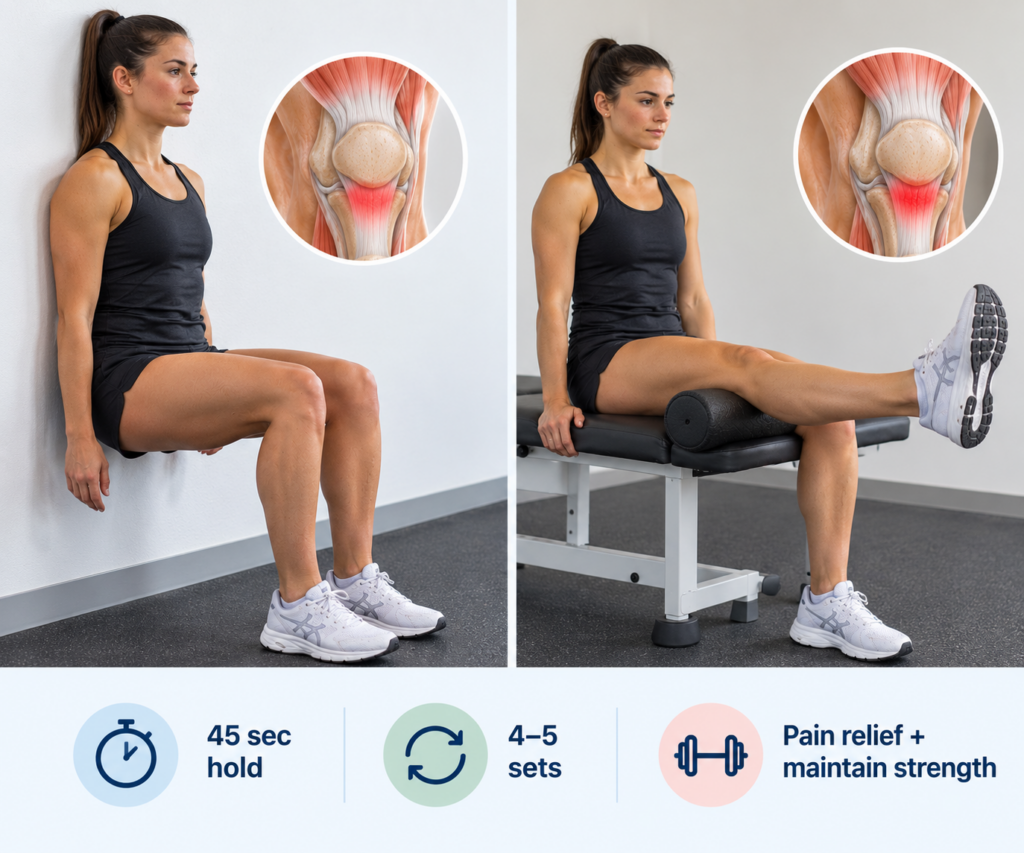
- Single-Leg Isometric Leg Extension: Seated at a leg extension machine with the knee held static at 60° of flexion.
- Bodyweight or Weighted Isometric Wall Sit: Hold a static squat position against a wall with knees bent between 45° and 60°.
Execution Guidelines
- Intensity: High load / high effort (approx. 70–80% of maximum voluntary contraction).
- Duration: 45-second holds per set.
- Rest: 2 minutes of rest between sets to allow neuromuscular recovery.
- Frequency: 4 to 5 sets, performed 1–2 times daily as needed for pain relief.
Summary and Next Steps
Patellar tendinopathy occurs when high-impact landing forces exceed the spring-like capacity of the patellar tendon. While dynamic landing causes high strain and irritation, heavy isometric holds provide immediate pain relief and maintain strength without further tendon irritation.
Isometric loading is the first step in a complete rehabilitation pathway. A comprehensive rehabilitation program progresses from isometric holds to heavy-slow resistance (HSR) training, energy-storage loading, and sport-specific plyometrics.
References
- Rio, E., Kidgell, D., Purdam, C., Gaida, J., Moseley, G. L., Pearce, A. J., & Cook, J. (2015). Isometric exercise induces analgesia and reduces inhibition in patellar tendinopathy. British Journal of Sports Medicine, 49(19), 1277-1283.
- Cook, J. L., & Purdam, C. R. (2009). Is tendon pathology a continuum? A clinical model to explain the clinical presentations of tendinopathy. British Journal of Sports Medicine, 43(6), 409-416.
- Malliaras, P., Cook, J., Purdam, C., & Rio, E. (2015). Patellar tendinopathy: Clinical diagnosis, load management, and advice for challenging case presentations. Journal of Orthopaedic & Sports Physical Therapy, 45(11), 887-898.
- van Ark, M., Cook, J. L., Docking, S. I., Zwerver, J., Brink, M. S., van den Akker-Scheek, I., & Rio, E. (2016). Do isometric and isotonic exercise reduce pain in athletes with patellar tendinopathy in-season? A randomised clinical trial. Journal of Science and Medicine in Sport, 19(9), 702-706.