

When most people think of core stability, they picture visible abdominal muscles—six-packs, side planks, and heavy bracing. However, true dynamic stability relies on a far more sophisticated, pressurized control system deeper inside the body. At the base of this system sits the pelvic floor.
When the pelvic floor muscles fail to contract, release, or coordinate properly—a condition known as pelvic floor dysfunction (PFD)—the entire movement chain suffers. Patients often present to physical therapy with persistent low back pain, recurrent hip impingement, or a feeling of instability during running or lifting, completely unaware that their primary mechanical deficit originates within the pelvis.
Here is a look at why the pelvic floor is essential for functional movement, how dysfunction disrupts dynamic stability, and how pelvic health physiotherapy provides a path toward total body recovery.
1. The Anatomy of Dynamic Stability: The “Canister” Model
To understand how pelvic floor dysfunction impairs movement, we must look at the trunk as a pressurized cylinder or “core canister”:
- Top: The Diaphragm
- Bottom: The Pelvic Floor Muscles (PFM)
- Sides/Front: The Transversus Abdominis (TrA)
- Back: The Lumbar Multifidus
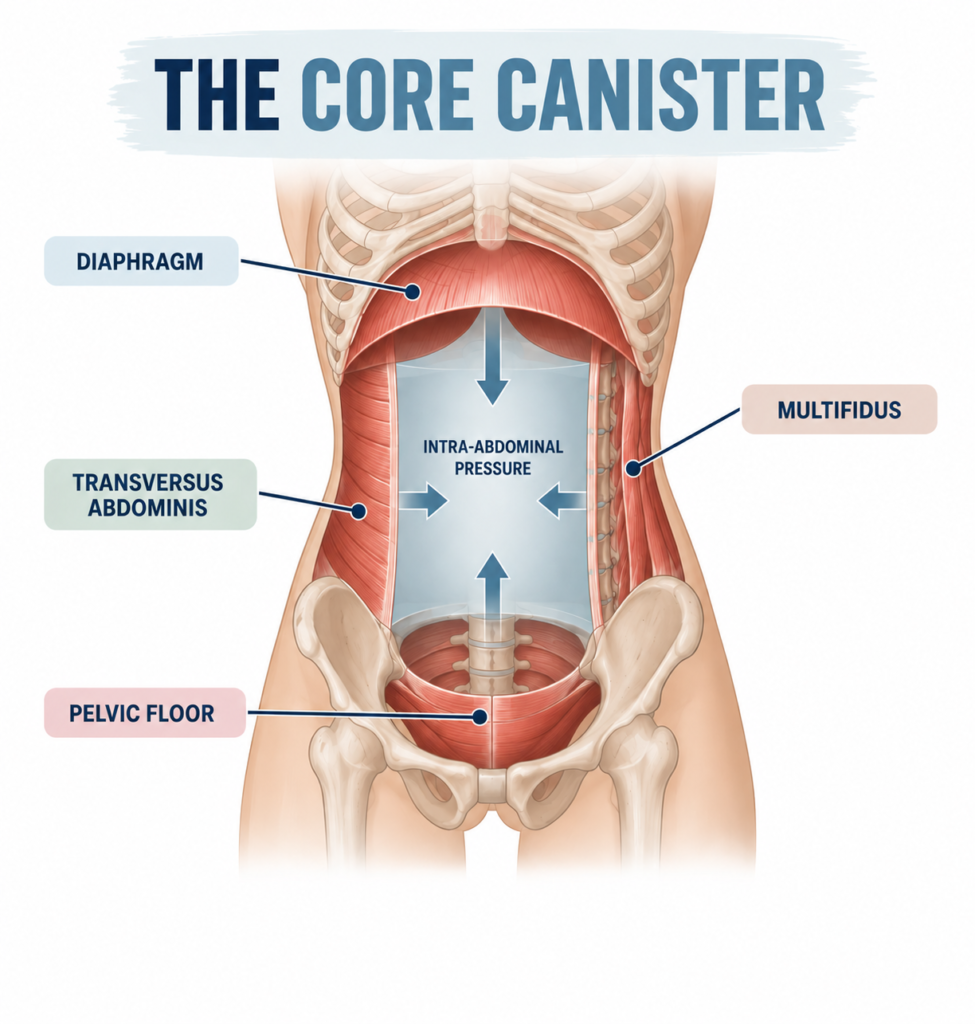
These structures operate synergistically to regulate Intra-Abdominal Pressure (IAP). When you inhale, the diaphragm descends, expanding the abdominal cavity and pushing downward against the pelvic floor. To maintain optimal pressure and balance the spine, the pelvic floor must gently lengthen under load while maintaining tension, then contract and lift dynamic force as you exhale or exert yourself.
If the base of this canister is compromised—whether due to muscular weakness, hypertonicity (over-tightness), or poor timing—the body loses its ability to manage IAP. The loss of bottom-up structural support creates micro-instability at the sacroiliac (SI) joints and lumbar spine, forcing external global movers (like the hamstrings, gluteus medius, or lumbar erectors) to work double-time to keep you upright.
2. Weakness vs. Hypertonicity: Dual Pathways to Instability
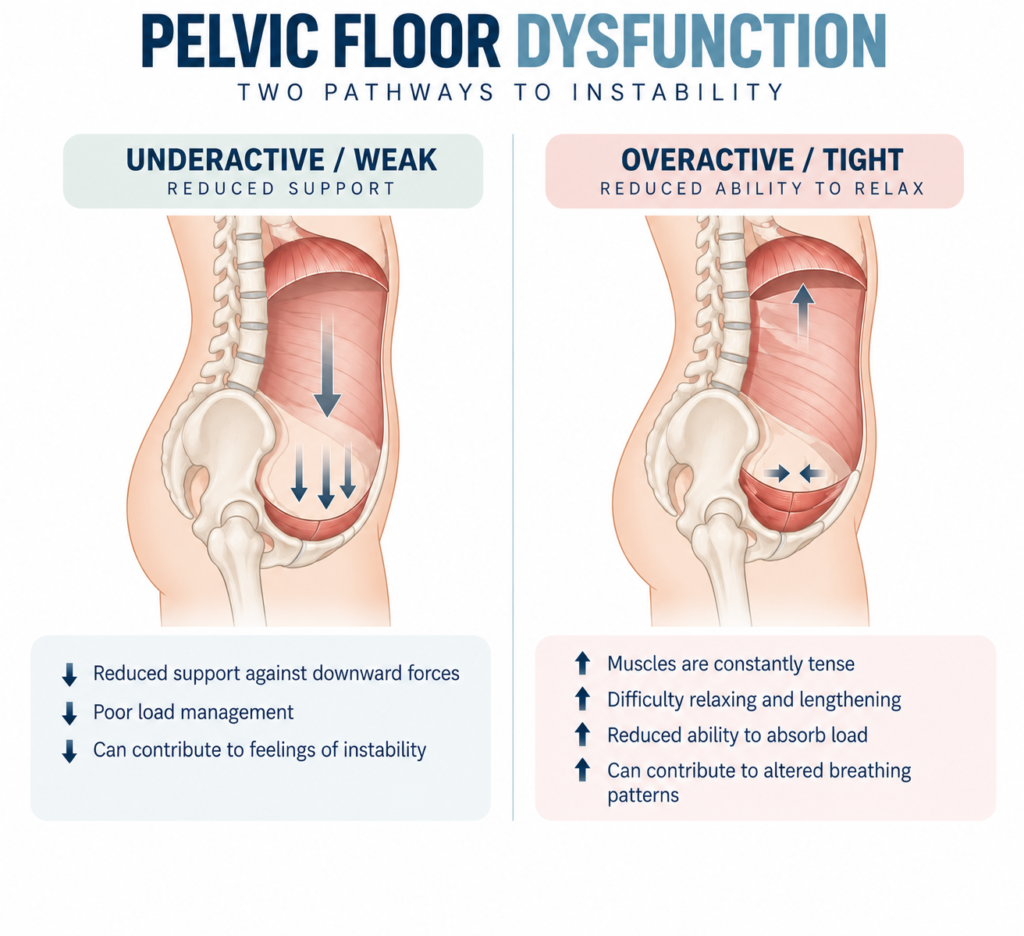
Pelvic floor dysfunction is not strictly a problem of “weak muscles.” In clinical practice, PFD falls into two primary profiles, both of which degrade dynamic balance and postural control:
Hypotonic (Underactive / Weak) Pelvic Floor
- The Mechanism: Lengthened or weakened pelvic floor muscles (frequently seen postpartum, after pelvic surgery, or due to prolonged strain) fail to provide sufficient upward support against downward forces.
- Impact on Movement: When running, jumping, or lifting, IAP pushes downward unchecked. This creates a load leak at the bottom of the core canister. The brain senses this instability and typically compensates by over-activating the lower back and hip flexors, leading to chronic stiffness and SI joint strain.
Hypertonic (Overactive / Tight) Pelvic Floor
- The Mechanism: Muscles that are chronically clamped down in a state of hyper-tension lose their functional range of motion. A muscular structure that cannot relax cannot absorb impact force effectively.
- Impact on Movement: A hypertonic pelvic floor acts like a rigid brick at the bottom of the core canister. During inspiration, the diaphragm cannot descend properly, leading to shallow chest breathing. This alters optimal rib cage alignment, increases sympathetic (fight-or-flight) nervous system tone, and disrupts the pre-programmed anticipatory firing of the deep core prior to limb movement.
3. Clinical Symptoms: Beyond Incontinence
While urinary urgency, frequency, and stress incontinence are classic signs of pelvic floor dysfunction, PFD frequently manifests as movement-related pain elsewhere in the kinetic chain:
- Unresolved Low Back & SI Joint Pain: Studies show that up to 95% of women presenting with chronic lumbopelvic pain also exhibit concurrent pelvic floor dysfunction.
- Persistent Hip & Deep Buttock Tightness: Tight pelvic floor muscles frequently mirror tight deep hip rotators (such as the obturator internus), leading to deep gluteal pain or lateral hip aching.
- Loss of Balance or Agility: Because the pelvic floor fires prior to arm or leg motion to stabilize the spine (anticipatory postural control), PFD leads to subtle delays in joint stabilization during high-velocity movements.
4. How Pelvic Health Physiotherapy Restores Movement Quality
Restoring dynamic stability requires far more than generic instruction to perform “Kegels.” In fact, prescribing strength exercises to an already hypertonic pelvic floor often exacerbates both pelvic pain and lumbar instability.
Pelvic health physiotherapy takes a comprehensive, integrated approach:
Complete Lumbopelvic Assessment
A specialized pelvic health physiotherapist evaluates whole-body biomechanics, inspecting posture, diaphragmatic breathing mechanics, hip mobility, and functional movement patterns (squats, single-leg stance, walking gait). Where appropriate, internal or real-time ultrasound evaluations assess muscle tone, strength, endurance, and precise coordination of the pelvic floor.
Neuromuscular Re-Education & Coordination
Physiotherapy restores the dynamic coordination between breathing and movement:
- Eccentric Control: Teaching the pelvic floor to lengthen gracefully under load (down-training high muscle tone).
- Concentric Power: Training the muscle to lift and contract in sync with exhalation during exertion.
Integration with Core Stability Exercises
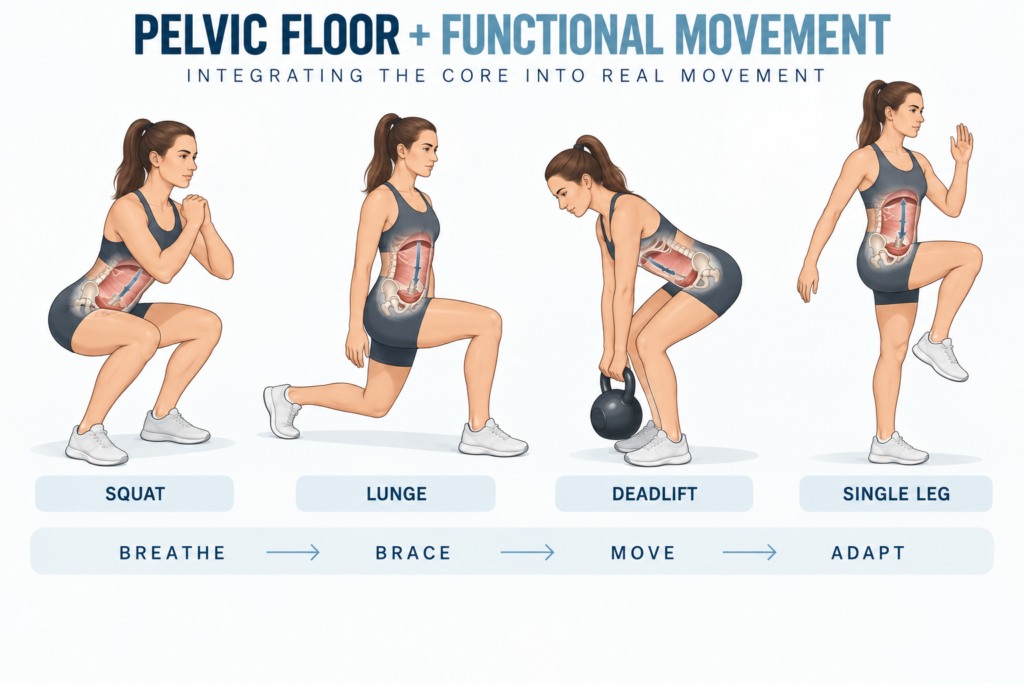
Isolated muscle activation is translated directly into dynamic function. We integrate pelvic floor recruitment into multidimensional movement patterns—such as deadlifts, lunges, and rotational movements—to ensure your core canister responds automatically to unpredictable real-world forces.
Move Without Limits
Dynamic stability starts from the inside out. If you are dealing with persistent back pain, hip tightness, or instability that hasn’t responded to traditional core exercises, your pelvic floor may be the missing piece of the puzzle.
Contact our team today to schedule an evaluation with a specialized pelvic health physiotherapist and rebuild your movement baseline from the ground up.
References
- Hodges, P. W., & Sapsford, R. (2007). Co-activation of the abdominal and pelvic floor muscles in response to rapid arm movements. Journal of Electromyography and Kinesiology, 17(5), 577-584.
- Dufour, S., Vandyken, B., Forget, M. J., & Vandyken, C. (2018). Association between lumbopelvic pain and pelvic floor dysfunction in women: A cross-sectional study. Musculoskeletal Science and Practice, 34, 47-53.
- Kobesova, A., & Kolar, P. (2014). Developmental kinesiology: Three levels of movement control in the assessment and treatment of the motor system. Journal of Bodywork and Movement Therapies, 18(1), 23-33.
- Smrcina, Z., Woelfel, S., & Burcal, C. (2022). A systematic review of the effectiveness of core stability exercises in patients with non-specific low back pain. International Journal of Sports Physical Therapy, 17(5), 766-779. https://doi.org/10.26603/001c.37251
- Nipa, S. I., Sriboonreung, T., Paungmali, A., & Phongnarisorn, C. (2022). The effects of pelvic floor muscle exercise combined with core stability exercise on women with stress urinary incontinence following the treatment of nonspecific chronic low back pain. Advances in Urology, 2022, 1-8. https://doi.org/10.1155/2022/2051374