If you have ever been woken up by an aching pain on the outside of your hip while lying in bed, or felt a sharp pinch when standing up from a low couch, you are likely dealing with gluteal tendinopathy.
Historically misdiagnosed as “trochanteric bursitis,” modern research shows that the primary culprit behind lateral hip pain is usually irritation of the gluteus medius and gluteus minimus tendons (Grimaldi et al., 2015).
The Root Cause: Compression vs. Tension
Tendons are built to withstand heavy pulling forces (tensile loads). They act like strong synthetic ropes, transferring power from your gluteal muscles to your femur to keep your pelvis level when you walk, run, or balance on one leg.
However, gluteal tendons have a major design vulnerability: compression.
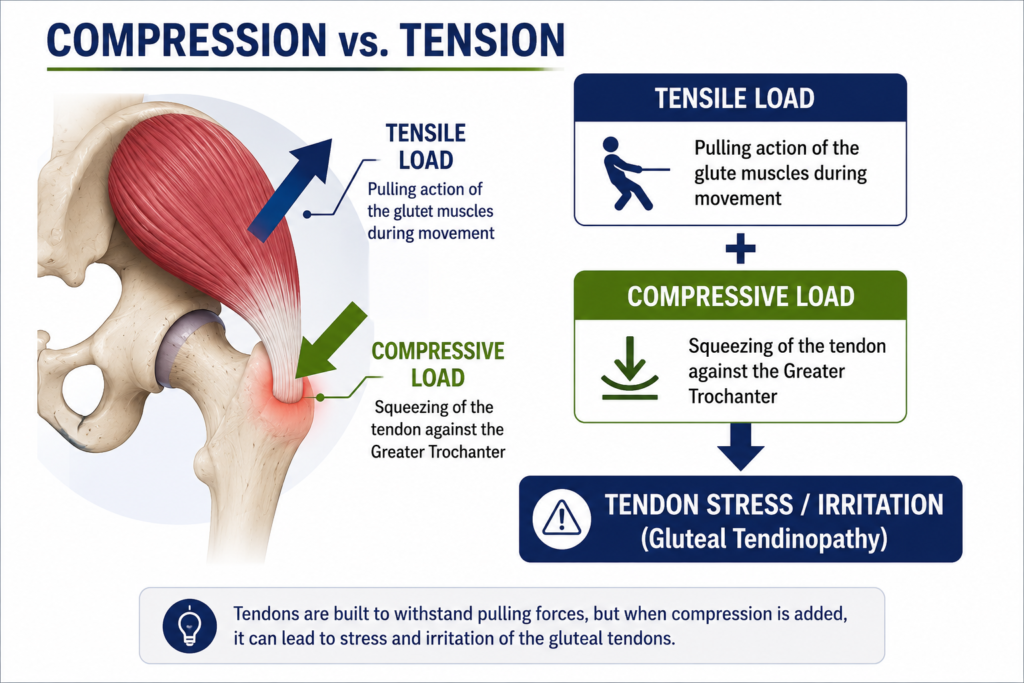
The gluteal tendons wrap over the greater trochanter—the hard, bony point on the outside of your hip. When your thigh moves inwards toward or past the midline of your body (a movement called hip adduction), the iliotibial band (ITB) and gluteal tendons are pulled taut across this bone. This creates a “nutcracker effect,” squishing the tendon matrix directly against the bone (Grimaldi & Fearon, 2015).
Why Is the Pain So Much Worse When Lying on Your Side?
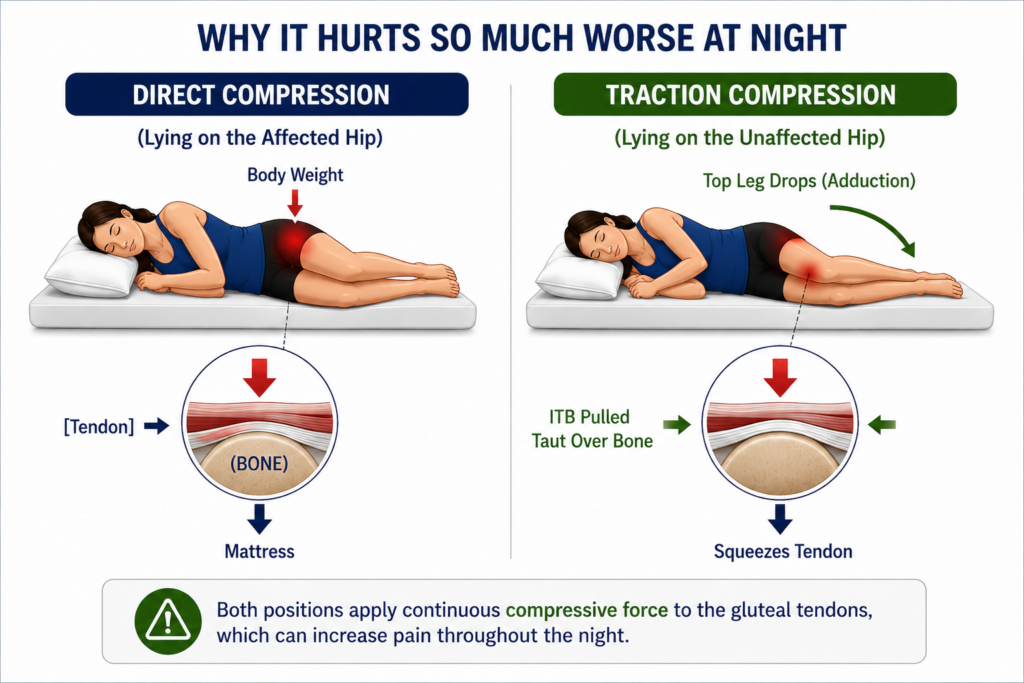
Night pain is one of the classic signatures of gluteal tendinopathy. It happens for two primary mechanical reasons depending on which side you sleep on:
1. Lying on the Sore Side (Direct Compression)
When you lie directly on the painful hip, your body weight drives the greater trochanter straight into the mattress. This creates localized, static, compressive pressure on the inflamed gluteal tendon and its underlying bursa.
2. Lying on the Unaffected Side (Traction Compression)
If you roll over to your good side to protect the painful hip, the top leg tends to drop downward across your body into adduction. This position pulls the ITB tight over the top hip’s greater trochanter like a strap on a drum, applying continuous compressive force to the tendon for hours at a time.
Other Provocative Everyday Postures
The same compressive mechanism explains why other everyday habits trigger your pain:
- Sitting with legs crossed (forces hip adduction).
- Standing “hanging” on one hip (drops the opposite pelvis, compressing the supporting hip).
- Stretching the glutes by pulling the knee to the opposite shoulder (this squishes the tendon further).
Why Rest Alone Doesn’t Work (And Why “Loading” Does)
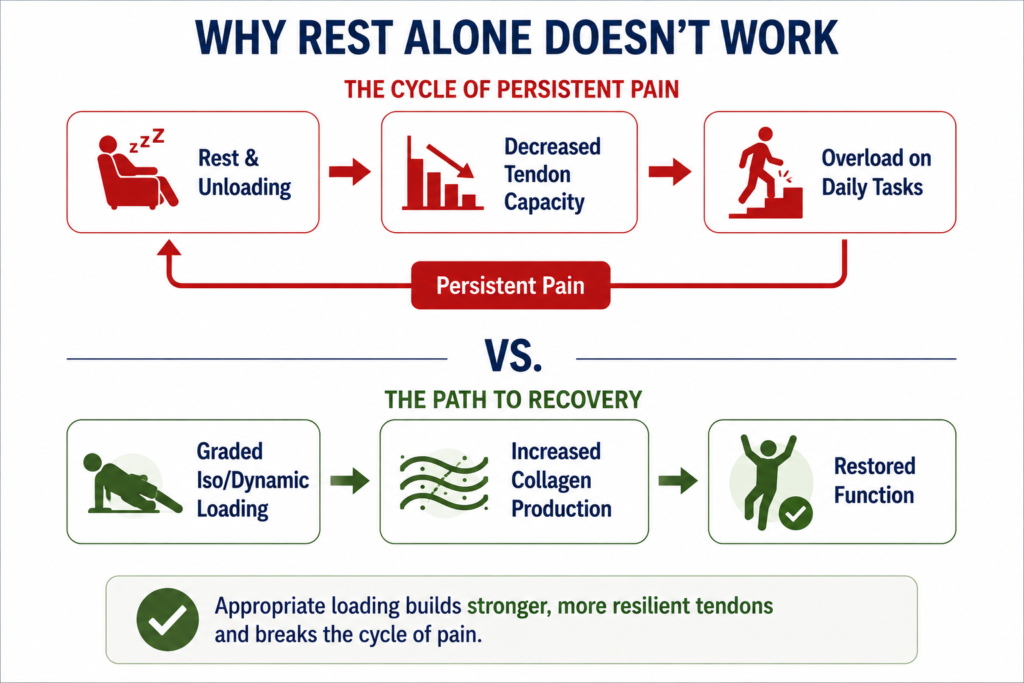
When a tendon hurts, the natural instinct is to rest it completely. While resting will calm the pain down temporarily, it also causes the tendon matrix to lose strength and capacity. When you eventually return to walking, climbing stairs, or exercising, the weakened tendon gets overloaded again immediately—creating a chronic cycle of pain.
Mechanical loading is the only stimulus that signals tendon cells (tenocytes) to produce collagen, realign fibers, and build load-bearing capacity (Mellor et al., 2018).
The 3-Stage Loading Roadmap
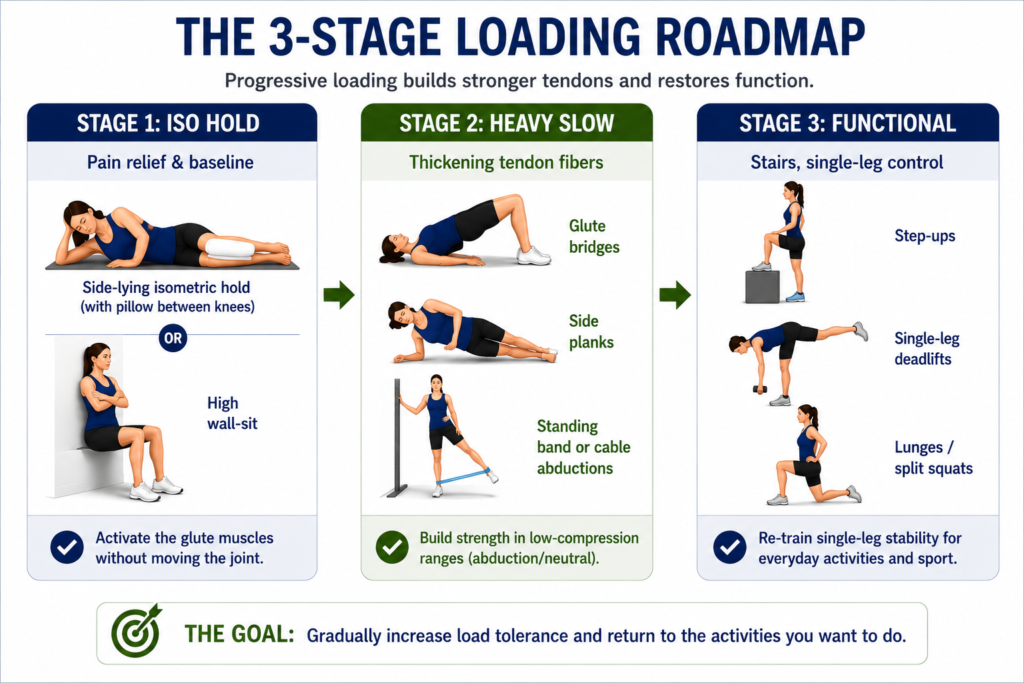
Rehabilitating gluteal tendinopathy involves progressive, controlled loading while minimizing positions of extreme compression (Grimaldi & Fearon, 2015).
Stage 1: Isometric Loading (Pain Management)
- Goal: Tense the gluteal muscles without moving the joint (isometrics). This exerts a analgesic (pain-numbing) effect on the tendon without adding friction or compressive stretch.
- Key Exercise: Side-lying isometric hold (with pillows between the knees to maintain a neutral hip position) or a high wall-sit.
Stage 2: Heavy, Slow Resistance (Building Capacity)
- Goal: Restore the strength of the gluteus medius and minimus muscles in low-compression ranges (abduction/neutral positions).
- Key Exercises: Glute bridges, side planks, standing cable or band abductions (keeping the leg in line with the body, never crossing behind).
Stage 3: Functional & Dynamic Loading
- Goal: Re-train single-leg stability for walking, stair climbing, and running.
- Key Exercises: Step-ups, single-leg deadlifts, and lunges while maintaining proper pelvic alignment.
Quick Fixes for Tonight’s Sleep
To immediately relieve night pain while your tendons heal:
- If sleeping on your back: Place a pillow under your knees to reduce tension on your hips and lower back.
- If sleeping on your non-painful side: Place one or two thick pillows between your knees and ankles to keep your top leg parallel to the bed (stopping it from dropping into adduction).
- If sleeping on the affected side: Place a soft foam topper or eggcrate mattress pad underneath you to redistribute pressure away from the bony point of the hip.
References
Grimaldi, A., & Fearon, A. (2015). Gluteal tendinopathy: Integrating pathomechanics and clinical features in its management. Journal of Orthopaedic & Sports Physical Therapy, 45(11), 910–922. https://doi.org/10.2519/jospt.2015.5829
Grimaldi, A., Mellor, R., Hodges, P., Bennell, K., Wajswelner, H., & Vicenzino, B. (2015). Gluteal tendinopathy: A review of mechanisms, assessment and management. Sports Medicine, 45(8), 1107–1119. https://doi.org/10.1007/s40279-015-0336-5 Cited by: 233
Mellor, R., Grimaldi, A., Wajswelner, H., Collie, A., Bennell, K., & Vicenzino, B. (2018). Education plus exercise versus corticosteroid injection use versus a wait and see approach on global outcome and pain scores for gluteal tendinopathy: Prospective, single blinded, randomised clinical trial. BMJ, 361, k1662. https://doi.org/10.1136/bmj.k1662