

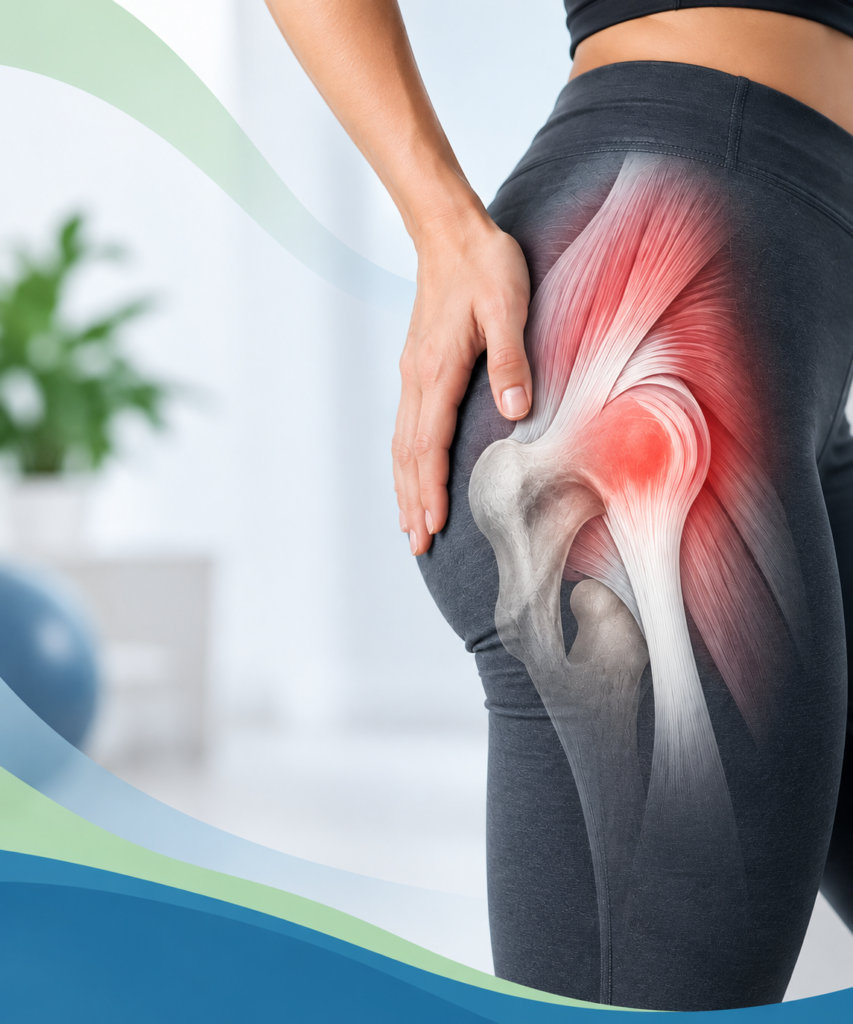
If you have spent months struggling with persistent pain on the outside of your hip, you have likely been diagnosed with trochanteric bursitis. You may have been told that a small fluid-filled sac (bursa) on the side of your hip is inflamed, and that rest, ice, stretching, or a corticosteroid injection is the cure.
Yet, for thousands of patients, the pain keeps coming back. Why? Because isolated trochanteric bursitis is rarely the primary source of chronic outer hip pain. Modern musculoskeletal research shows that focusing solely on the bursa misses the true biomechanical root cause.
The Shift: From “Bursitis” to Greater Trochanteric Pain Syndrome (GTPS)
For decades, any tenderness over the bony prominence on the side of the hip (the greater trochanter) was labeled as trochanteric bursitis. Modern magnetic resonance imaging (MRI) and ultrasound studies have completely transformed this understanding.
Radiological and histological evaluations reveal that isolated bursitis occurs in less than 20% of symptomatic patients. Instead, the primary pathology is usually gluteal tendinopathy—degeneration, micro-tearing, or overload of the gluteus medius and gluteus minimus tendons where they attach to the greater trochanter.
The bursa rarely becomes inflamed on its own. Rather, it reacts secondarily to friction and compression caused by compromised gluteal tendons. Medical professionals now use the umbrella term Greater Trochanteric Pain Syndrome (GTPS) to accurately describe this spectrum of lateral hip pain.
Common Myths vs. Biomechanical Reality
Understanding how GTPS develops requires dispelling a few widespread misunderstandings:
- Myth 1: “The bursa is inflamed, so resting and resting more will fix it.”
- Reality: Tendons need load to heal. Total rest causes gluteal tendon capacity to shrink further, making the hip even more sensitive when returning to daily activity.
- Myth 2: “Stretching your IT band and gluteals will relieve hip tension.”
- Reality: Aggressive stretching actually worsens the condition. Pulling the leg across the body (adduction) squashes the gluteal tendons and bursa directly against the greater trochanter bone.
- Myth 3: “Cortisone injections are a long-term cure.”
- Reality: Corticosteroid injections offer short-term pain relief by dampening acute irritation, but they do not rebuild tendon load tolerance. Pain frequently recurs once the medication wears off if the underlying movement mechanics remain unaddressed.
The Biomechanical Root Cause: Compression and Load Capacity
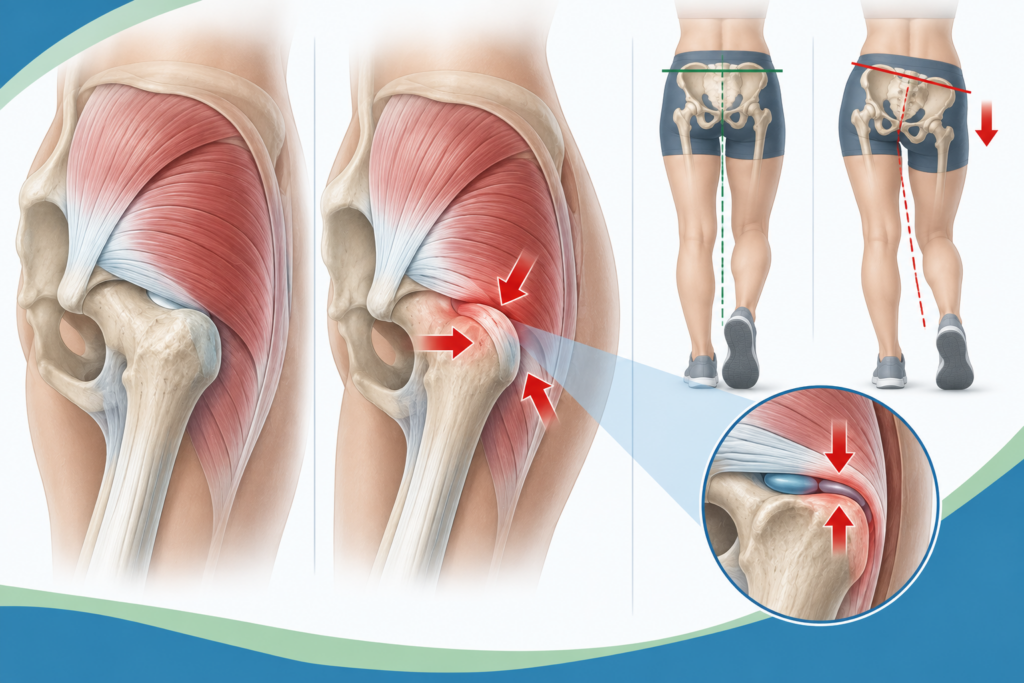
The true culprit in GTPS is a combination of excessive compressive forces and reduced tendon load capacity.
- Tensile vs. Compressive Loading: Tendons handle straight-line tension well, but struggle under lateral compression. Activities that push the hip into adduction—such as sitting with crossed legs, standing with weight slouched onto one hip, or sleeping on your side without a pillow—compress the tendon against the bone.
- Pelvic Instability: The gluteus medius acts as the primary lateral stabilizer of the pelvis. When walking or running, it keeps your hips level. If the gluteals are weak or fatigued, the non-weight-bearing side of the pelvis drops (known as a Trendelenburg gait). This pelvic drop drags the stance hip into compression, multiplying stress on the tendon during every step.
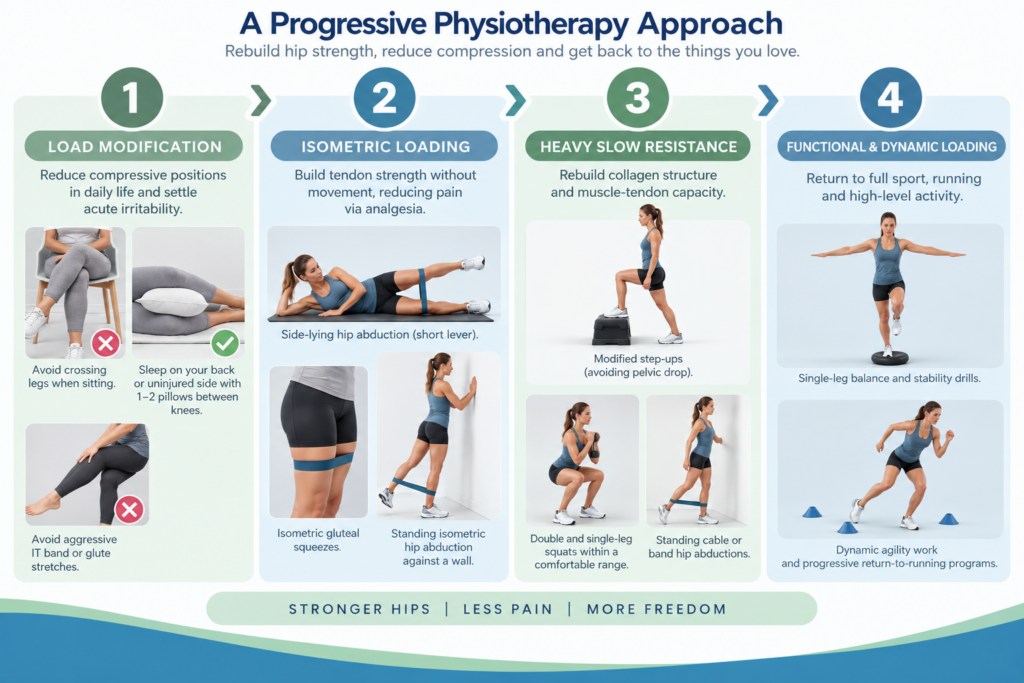
Rebuilding the Hip: A Progressive Physiotherapy Approach
Effective treatment focuses on restoring load capacity to the gluteal tendons while eliminating compression during daily movement.
References
- Mellor, R., et al. (2018). Education plus exercise versus corticosteroid injection use versus a wait and see approach on global outcome and pain severity in people with gluteal tendinopathy: randomised clinical trial. BMJ, 361, k1662.
- Grimaldi, A., & Fearon, A. (2015). Gluteal Tendinopathy: Integrating Pathomechanics and Clinical Evidence in Rehabilitation. Journal of Orthopaedic & Sports Physical Therapy, 45(11), 910–922.
- Speers, C. J., & Bhogal, G. S. (2017). Greater trochanteric pain syndrome: a review of diagnosis and management in general practice. British Journal of General Practice, 67(663), 478–479.
- Docking, S. I., et al. (2015). Tendinopathy: Is alterated structure the only contributor to clinical presentation? Sports Health, 7(6), 535–542.