

Few sensations disrupt a training block quite like a sharp, pinching ache deep in the front of your groin. Whether it strikes at the bottom of a heavy barbell back squat or while planting hard to cut across the turf, Femoroacetabular Impingement (FAI)—commonly known as hip impingement—is a leading cause of hip and groin pain in active populations.
If an X-ray or MRI has recently revealed “Cam” or “Pincer” morphology, it’s easy to feel like your hip joint is structurally doomed. The truth, however, is much more encouraging. Anatomy is not destiny. With the right biomechanical adjustments and load management strategies, you can navigate FAI and get back to performing at your peak.
What Is FAI? Decoding Cam vs. Pincer Morphology
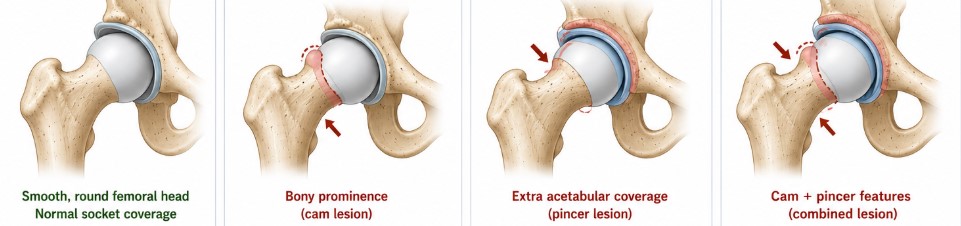
The hip is a classic ball-and-socket joint where the femoral head (ball) meets the acetabulum (socket). FAI occurs when extra bone grows along one or both parts of the joint, leading to abnormal contact during end-range movements.
1. Cam Lesions (The “Ball” Issue)
A Cam morphology occurs when the head of the femur isn’t perfectly round. Instead, an extra ridge of bone develops at the femoral head-neck junction. During high hip flexion and internal rotation—such as the bottom of a deep squat—this bony prominence grinds against the acetabular rim and labrum.
2. Pincer Lesions (The “Socket” Issue)
Pincer morphology happens when the acetabulum (socket) overcovers the femoral head. Because the socket rim extends too far forward, the neck of the femur pinches the labrum prematurely during movement.
3. Combined Morphology
Most clinical cases aren’t isolated; the vast majority of symptomatic athletes exhibit a mixed/combined pattern of both Cam and Pincer features.
Crucial Clinical Takeaway: Up to 30–50% of asymptomatic, high-performing athletes show Cam or Pincer features on imaging. Bony morphology alone does not equal pain. Pain only occurs when loading demands exceed your hip tissue’s tolerance capacity.
The Perfect Storm: Squats and Cutting Mechanics
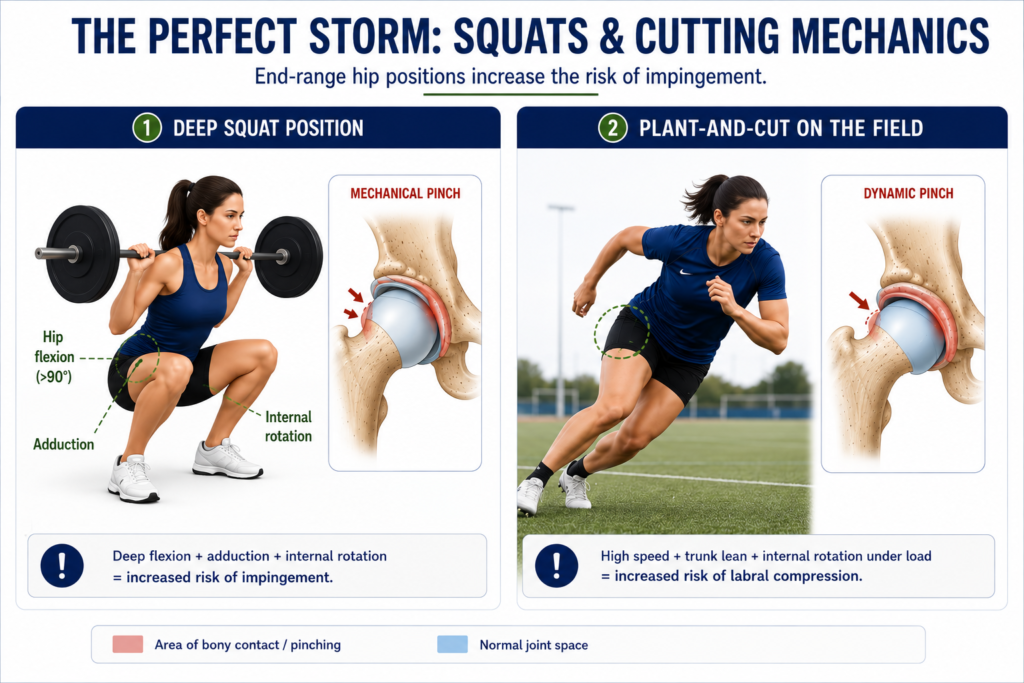
Why do deep squats and field sports trigger FAI symptoms so aggressively? It comes down to end-range hip position.
- At the Bottom of a Deep Squat: The hip experiences high flexion paired with varying degrees of adduction and internal rotation. As you drop past 90 degrees of flexion, the available clear space between the femur and socket decreases, creating mechanical pinch points.
- On the Field (Plant-and-Cut): Changing direction requires rapid deceleration, trunk lean, and forceful hip internal rotation under load. In sports like football, rugby, or soccer, this rapid dynamic loading traps the labrum against the bony rim.
4-Step Physiotherapy Roadmap to Manage FAI
Managing FAI isn’t about avoiding movement forever—it’s about training smarter to restore joint capacity while respecting mechanical boundaries.
1. Modify the Depth and Stance (Squat Tweaks)
You don’t need to quit squatting; you just need to adjust the levers:
- Widen your stance slightly and allow 15–30° of natural external foot flare. This clears space for the femoral neck to sit within the socket without premature contact.
- Limit depth to pain-free ranges (e.g., box squats to parallel) while building capacity, then reintroduce depth progressively.
- Shift to a high-bar back squat or front squat to keep the torso more upright, which reduces total hip flexion compared to a low-bar position.
2. Restore Hip Internal and External Rotation Mobility
While you cannot stretch away extra bone, capsule stiffness and hypertonic soft tissue often restrict clean joint glide:
- Perform gentle dynamic capsular mobilizations (e.g., quadruped hip rocks with band distraction).
- Target the deep lateral rotators, hip flexors, and adductors without forcing end-range impingement positions (avoid aggressive “pigeon pose” variations if they reproduce pinching pain).
3. Build Rotational Stability & Glute Motor Control
Bony impingement is amplified when the femoral head migrates forward in the socket during movement. Strengthening the posterior chain acts as an internal brake, holding the ball centered in the socket:
- Gluteus Medius & Maxima: Heavy hip thrusts, Romanian deadlifts, and lateral band walks.
- Deep Hip Rotators: Controlled articular rotations (CARs) and side-lying clam variations emphasizing motor control over ego weight.
4. Recondition Field-Specific Cutting Mechanics
For field athletes, returning to sport requires structured re-exposure to dynamic deceleration:
- Progress from predictable, closed-loop lateral drills (shuffle, low-intensity cutting) to open-loop reactive change-of-direction drills.
- Coach proper trunk-on-pelvis alignment during cuts to prevent excessive medial collapse (valgus) and extreme hip internal rotation under speed.
Summary & Next Steps
Experiencing hip impingement doesn’t mean your squat days are over or that surgery is inevitable. High-quality physiotherapy focused on motor control, load management, and movement modification remains the recommended first-line treatment.
If hip pain is keeping you from squatting deep or cutting on the field, consult a qualified sports physiotherapist for a comprehensive assessment.
Key Evidence & References
- Griffin, D. R., et al. (2016). The Warwick Agreement on femoroacetabular impingement syndrome (FAI syndrome): an international consensus statement. British Journal of Sports Medicine, 50(19), 1169-1176.
- Reiman, M. P., et al. (2018). Surgical and non-surgical management of femoroacetabular impingement syndrome: a systematic review and meta-analysis. Journal of Orthopaedic & Sports Physical Therapy, 48(8), 632-648.
- Dickenson, E., et al. (2016). Cam morphology and hip osteoarthritis: is there a association? Journal of Hip Preservation Surgery, 3(4), 268-277.
- Frank, J. M., et al. (2015). Prevalence of Femoroacetabular Impingement Imaging Findings in Asymptomatic Volunteers: A Systematic Review. Arthroscopy: The Journal of Arthroscopic & Related Surgery, 31(6), 1199-1204.