

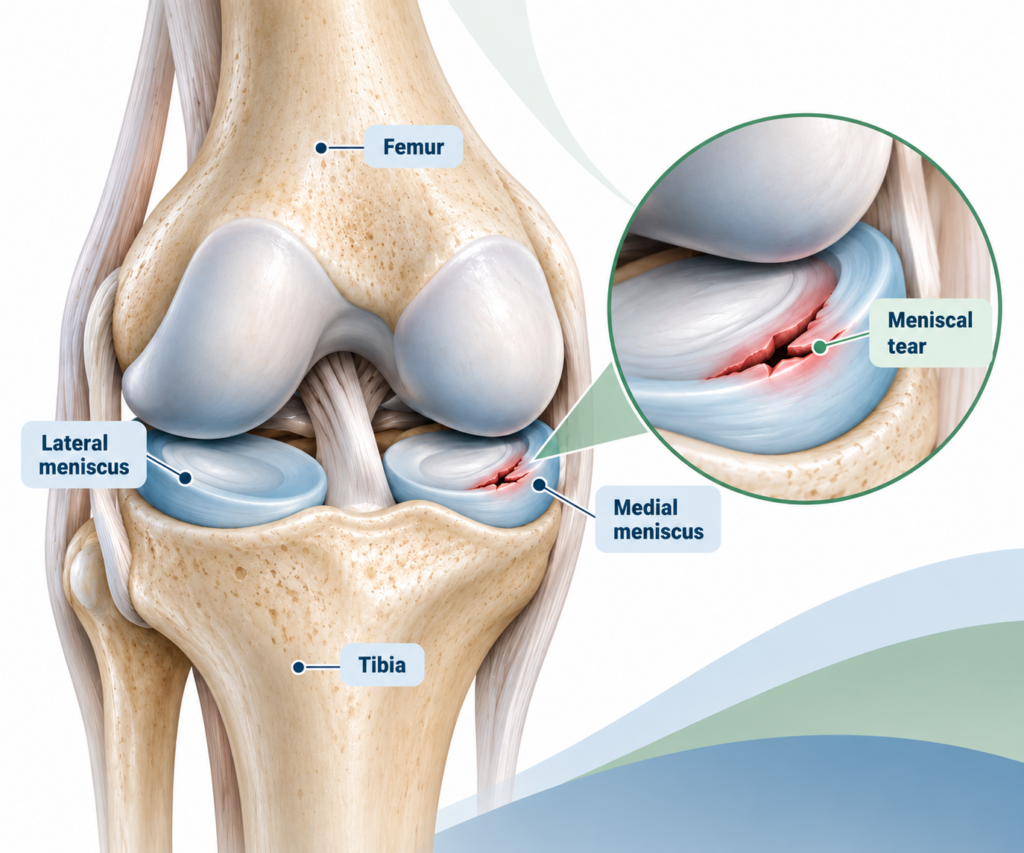
A sudden tweak on the sports field or a persistent ache while squatting often leads to an MRI diagnosis: a meniscal tear. Historically, the immediate clinical reaction was to refer patients directly to orthopedic surgeons for arthroscopic partial meniscectomy (APM).
However, over the last decade, landmark clinical research has transformed how physical therapists and orthopaedic experts manage meniscal injuries. For the vast majority of patients—particularly those with degenerative tears or non-locking traumatic tears—conservative exercise therapy provides functional recovery and pain relief equivalent to surgery, without surgical risks or long-term joint degeneration (Brignardello-Petersen et al., 2017).
Understanding when conservative physiotherapy is the optimal primary pathway, when surgical consultation is appropriate, and what evidence-based rehabilitation involves can guide key treatment decisions.
The Clinical Shift: What the Evidence Reveals
The meniscus acts as the knee joint’s primary shock absorber, distributing load across the articular cartilage and assisting with joint stability. When a tear occurs, removing meniscal tissue via surgery alters knee biomechanics and reduces contact surface area, which can accelerate secondary osteoarthritic changes.
High-quality randomized controlled trials (RCTs) comparing arthroscopic meniscectomy with structured physical therapy demonstrate minimal to no significant difference in long-term pain or functional outcomes (Azam & Shenoy, 2016; Brignardello-Petersen et al., 2017). Furthermore, recent clinical trials examining younger, active populations with traumatic non-locking meniscal tears found that initiating physical therapy first delivered outcomes comparable to early arthroscopic surgery (van der Graaff et al., 2022).
These findings led major orthopedic and sports medicine governing bodies to update clinical practice guidelines: Supervised physical therapy should serve as the primary first-line intervention for degenerative and uncomplicated traumatic meniscal tears.
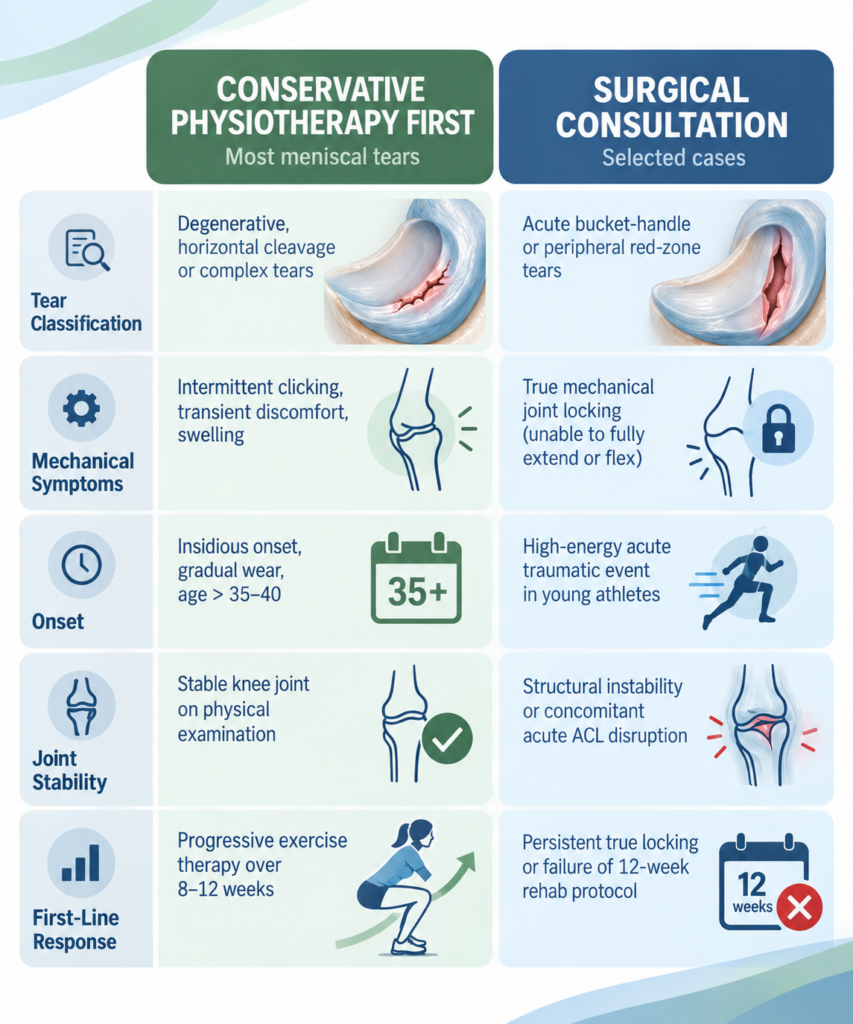
Clinical Triage: Conservative vs. Surgical Decision Tree
Determining whether to pursue conservative rehabilitation or consult an orthopaedic surgeon depends on the mechanism of injury, symptom characteristics, and joint mechanical integrity.
The 3-Phase Progressive Physiotherapy Protocol
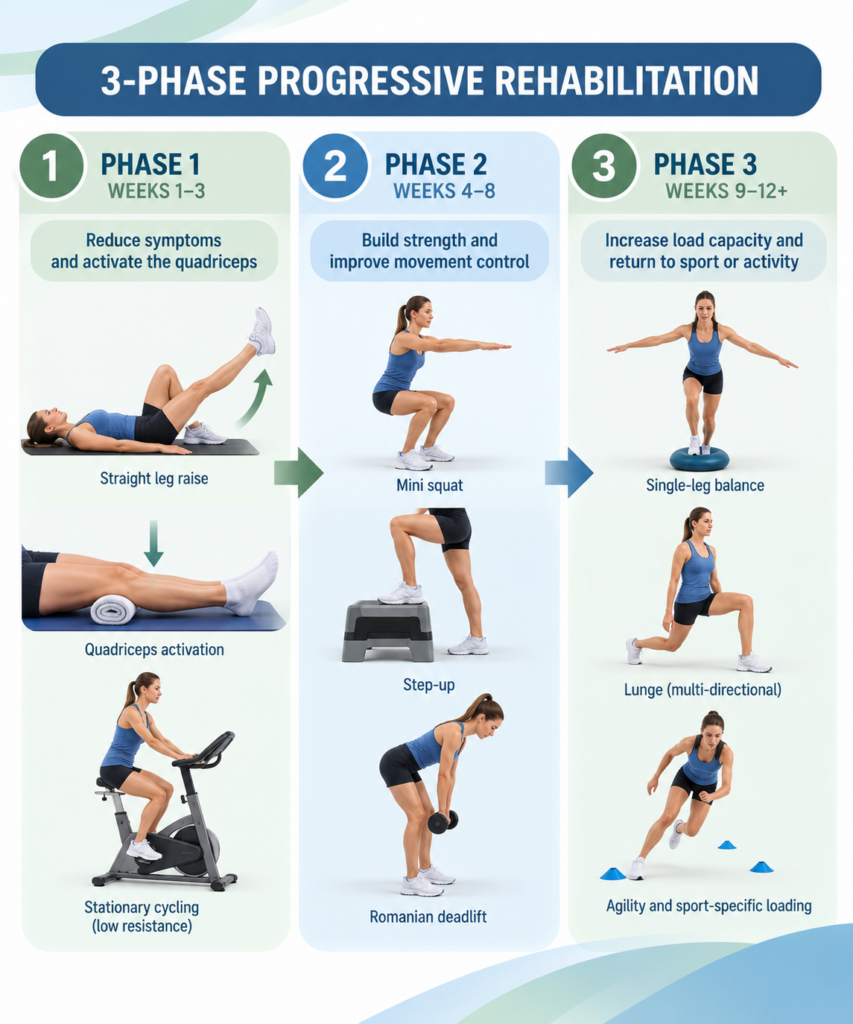
Opting for conservative management does not mean “wait and see.” It is an active, structured rehabilitation program aimed at neuromuscular control, dynamic joint stability, and strengthening the surrounding kinetic chain to compensate for altered meniscal load distribution.
Phase 1: Symptom Reduction & Quadriceps Activation (Weeks 1–3)
- Primary Focus: Control joint effusion, restore full terminal knee extension, and prevent arthrogenic muscle inhibition (AMI) in the quadriceps.
- Key Interventions:
- Quadriceps setting and straight leg raises (SLR) with verbal/tactile cues.
- Open-chain knee extension in pain-free arcs ($90^\circ$ to $40^\circ$).
- Gentle stationery cycling (low resistance) to promote joint fluid circulation.
- Ice, compression, and load modification.
Phase 2: Dynamic Load Acceptance & Closed-Chain Strength (Weeks 4–8)
- Primary Focus: Build multi-planar strength in the hip gluteals, hamstrings, and quadriceps while restoring functional lower-limb alignment.
- Key Interventions:
- Closed-chain resistance exercises: Leg press, mini-squats, and step-ups within comfort limits.
- Romanian deadlifts and hip thrusts for posterior chain reinforcement.
- Sensorimotor and proprioceptive training using single-leg balance tasks and unstable surfaces.
Phase 3: High-Load Capacity & Return to Sport/Activity (Weeks 9–12+)
- Primary Focus: Prepare the joint for high-impact forces, rotation, deceleration, and sport-specific movements.
- Key Interventions:
- Multi-directional lunges and dynamic plyometric progressions.
- Agility ladder drills, cutting/deceleration training, and field-specific loading.
- Maximal strength training (targeting > 90% Limb Symmetry Index on dynamometry).
When to Re-evaluate for Surgery
Conservatively managing a meniscal tear does not rule out surgical intervention in the future. If a patient completes a structured 8- to 12-week supervised physical therapy program without meaningful functional improvement, or experiences recurring true mechanical joint locking, orthopedic re-evaluation for repair or partial meniscectomy remains a viable secondary option (Azam & Shenoy, 2016). Crucially, starting with conservative management does not compromise surgical outcomes if surgery is required later.
References
Azam, M., & Shenoy, R. (2016). The role of arthroscopic partial meniscectomy in the management of degenerative meniscus tears: A review of the recent literature. The Open Orthopaedics Journal, 10(1), 797–804. https://doi.org/10.2174/1874325001610010797
Cited by: 23
Brignardello-Petersen, R., Guyatt, G. H., Buchbinder, R., Poolman, R. W., Schandelmaier, S., Chang, Y., Sadeghirad, B., Evaniew, N., & Vandvik, P. O. (2017). Knee arthroscopy versus conservative management in patients with degenerative knee disease: A systematic review. BMJ Open, 7(5), e016114. https://doi.org/10.1136/bmjopen-2017-016114
Cited by: 195
van der Graaff, S. J. A., Eijgenraam, S. M., Meuffels, D. E., van Es, E. M., Verhaar, J. A. N., Hofstee, D. J., Auw Yang, K. G., Noorduyn, J. C. A., van Arkel, E. R. A., van den Brand, I. C. J. B., Janssen, R. P. A., Liu, W. Y., Bierma-Zeinstra, S. M. A., & Reijman, M. (2022). Arthroscopic partial meniscectomy versus physical therapy for traumatic meniscal tears in a young study population: A randomised controlled trial. British Journal of Sports Medicine, 56(15), 870–876. https://doi.org/10.1136/bjsports-2021-105059
Cited by: 32