

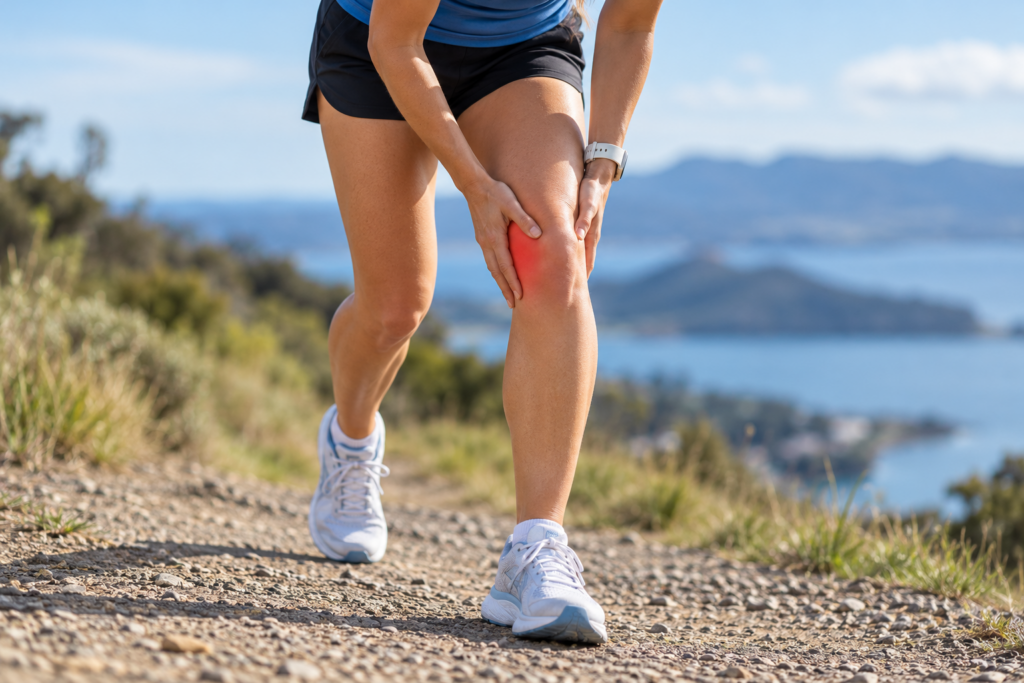
That sharp, burning pain on the outside of your knee—the one that hits like clockwork at kilometer six of a long run or halfway down a steep, technical descent—is one of the most frustrating experiences for runners and backcountry trampers alike.
Often labeled as simple “tightness,” Iliotibial Band (ITB) Syndrome is one of the most common causes of lateral knee pain in endurance athletes. Whether you are ramping up mileage for a marathon or tackling steep downhill sections with a loaded pack, understanding the true mechanics of ITB syndrome is the first step toward lasting recovery.
1. What Is ITB Syndrome? (Myth vs. Reality)
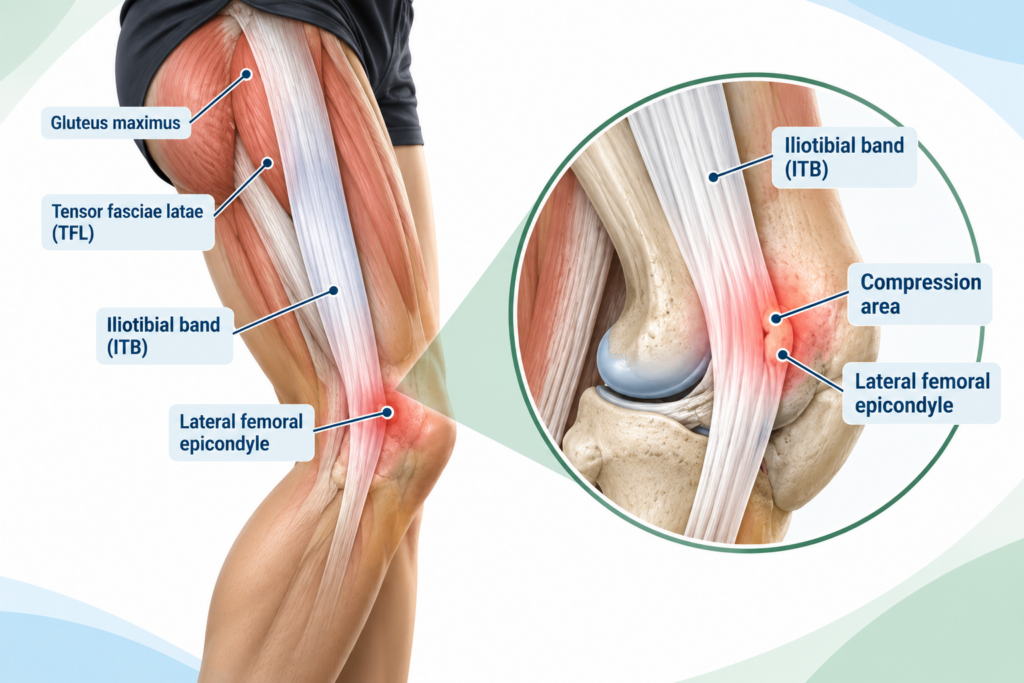
For years, the conventional view was that ITB syndrome was caused by a tight band rubbing back and forth over the lateral femoral epicondyle (the bony bump on the outside of the knee) like a friction towel.
Recent anatomical and biomechanical research has updated this model:
- Compression Over Friction: The ITB is a thick, fibrous band of connective tissue anchored securely to the femur. Beneath the distal ITB lies a highly vascularized, nerve-dense pad of fat and connective tissue. Rather than pure “friction,” the pain stems from repeated compression of this sensitive fat pad against the bone when the knee flexes and extends around 30 degrees (the “impingement zone”).
- You Can’t “Stretch” an ITB: The ITB has high tensile strength—it is structurally similar to a steel cable. Foam rolling or stretching the ITB itself does not lengthen the tissue. Instead, rehabilitation focuses on reducing compressive load, managing local tissue capacity, and strengthening the hip and pelvic stabilizers that control leg alignment.
2. Why It Flaunts Up: Marathons vs. Tramping Descents
While the underlying pain mechanism is similar, the biomechanical triggers differ slightly between road running and backcountry hiking:
Marathon Preparation
- Repetitive Angle: Running on flat asphalt locks the knee into repetitive flexion-extension cycles within that sensitive 30-degree range thousands of times per session.
- Rapid Volume Spikes: Sudden increases in weekly distance or intensity without adequate tissue adaptation.
- Cambered Roads & Track Direction: Constantly running on a sloped road surface or around a track in the same direction increases side-to-side biomechanical asymmetry.
Steep Tramping Descents
- Sustained Eccentric Loading: Descending steep gradients forces the quadriceps and gluteals to work eccentrically while the knee remains bent in or near the compression zone.
- Loaded Packs: Heavy packs increase ground reaction forces, compounding pelvic drop and knee strain.
- Fatigue & Instability: Uneven trail surfaces require rapid stabilization; as hip fatigue sets in, the knee is more prone to drifting inward (valgus collapse), increasing ITB strain.
3. Evidence-Based Rehabilitation Framework
Effective ITB rehabilitation moves through three distinct phases: calming local irritability, building targeted strength, and modifying biomechanics.
Phase 1: Symptom Reduction & Load Modification
- Modify, Don’t Stop: Reduce total running or tramping volume to a level that does not provoke sharp symptoms. Avoid downhill running and steep steps during acute flare-ups.
- Cross-Training: Maintain cardiovascular fitness with swimming or flat cycling (adjusting saddle height so the knee isn’t excessively bent at the top of the pedal stroke).
- Target Soft Tissues Around the ITB: Focus foam rolling or massage on the surrounding musculature—specifically the Tensor Fasciae Latae (TFL) and Gluteus Maximus—rather than pressing directly onto the painful bone at the knee.
Phase 2: Targeted Strengthening
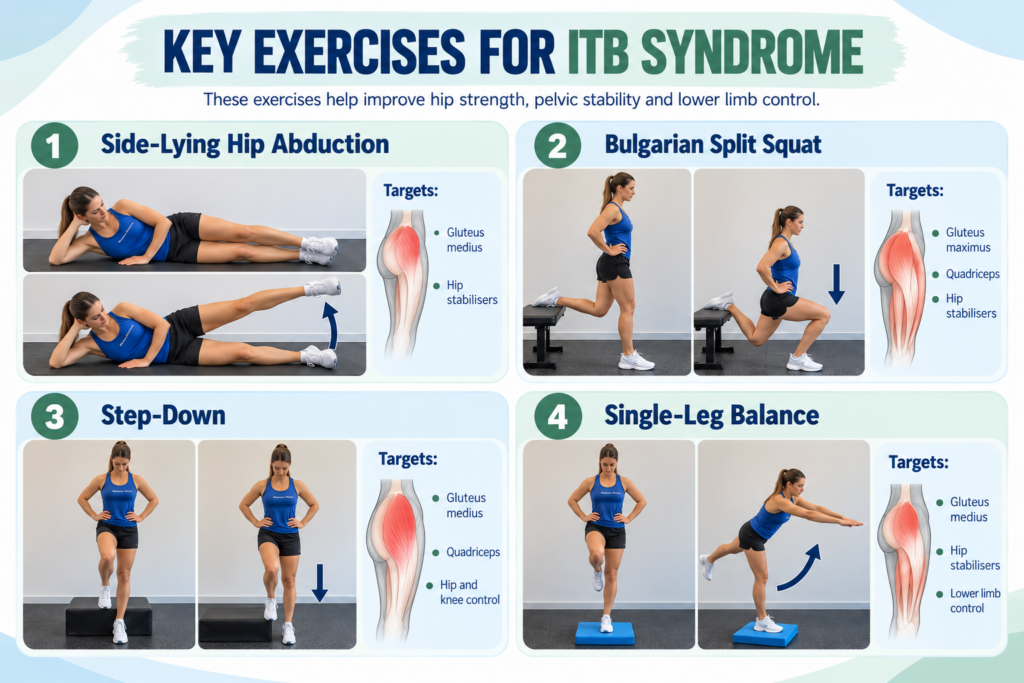
Strengthening the hip abductors and external rotators improves pelvic stability and prevents excessive knee inward collapse.
- Side-Lying Clamshells & Hip Abductions: Isolate the gluteus medius and deep rotators.
- Single-Leg Bulgarian Split Squats & Step-Downs: Build functional strength and eccentric control for downhill terrain.
- Heavy Slow Resistance (HSR): Weighted squats and deadlifts to build systemic load capacity.
Phase 3: Biomechanical Adaptation & Cues
- Increase Step Rate (Cadence): Increasing your running cadence by 5–10% reduces peak knee flexion and ground reaction forces, moving the knee quickly past the 30-degree compression zone.
- Widen Running Stride: Avoiding a “tightrope” foot-strike pattern reduces adductive forces at the knee.
- Tramping Technique: Use trekking poles on steep descents to offload up to 20–25% of joint stress from the lower limbs. Shorten your stride down steps rather than taking long leaps down ledges.
4. Summary & Action Steps
| Strategy | Marathon Preparation | Tramping Descents |
| Immediate Adjustment | Increase cadence by 5–10%; avoid cambered roads | Use dual trekking poles; shorten stride length |
| Target Muscle Groups | Gluteus Medius, Gluteus Maximus, TFL | Quadriceps (eccentric control), Gluteals, Core |
| Cross-Training Option | Flat pool running or low-resistance cycling | Rowing machine or incline treadmill walking |
| Key Prevention Cue | “Run wider” (avoid feet crossing mid-line) | “Land softly with bent knees, let poles take weight” |
References
- Fairclough, J., et al. (2006). “The functional anatomy of the iliotibial band during flexion and extension of the knee: implications for understanding iliotibial band syndrome.” Journal of Anatomy, 208(3), 309–316.
- Fairclough, J., et al. (2007). “Is iliotibial band syndrome really a friction syndrome?” BMC Musculoskeletal Disorders, 8(1), 52.
- Bramah, C., et al. (2018). “Is movement quality related to injury in runners? A prospective study.” American Journal of Sports Medicine, 46(12), 3023–3031.
- Heiderscheit, B. C., et al. (2011). “Effects of step rate manipulation on joint mechanics during running.” Medicine & Science in Sports & Exercise, 43(2), 296–302.
- Baker, R. L., & Fredericson, M. (2016). “Iliotibial Band Syndrome in Runners: Biomechanical Implications and Exercise Interventions.” Physical Medicine and Rehabilitation Clinics of North America, 27(1), 53–77.info